Motorcycle Chain Maintenance: The Complete Cleaning & Lubing Guide (2026)
By 6FOOT4HONDA · 12 min read · Mar 3, 2026 · Updated Mar 4, 2026
This post may contain affiliate links. We only recommend gear we'd use ourselves. If you click a link and make a purchase, we may earn a small commission at no extra cost to you.
In This Article
To maintain your motorcycle chain, clean and lube it every 300-600 miles using an O-ring safe chain cleaner, a grunge brush, and wax or wet chain lube. Check chain slack at the midpoint between sprockets, keeping it within 20-35mm of vertical play. A well-maintained chain lasts 15,000-25,000 miles.
Your motorcycle chain is the single hardest-working part on your bike. Every time you twist the throttle, the chain transfers all of that power from the engine to the rear wheel — under massive tension, at high speed, while exposed to road grime, water, and debris.
A well-maintained chain lasts 15,000-25,000 miles. A neglected chain lasts 5,000-8,000 miles — and takes your sprockets with it when it dies, turning a $50 chain lube habit into a $400+ chain-and-sprockets replacement.
This is the easiest maintenance you can do yourself — and just one part of a complete motorcycle maintenance routine. It takes 15 minutes, costs almost nothing, and dramatically extends the life of your drivetrain. Here's exactly how.
How Often Should You Clean and Lube Your Chain?
Every 300-600 miles, or after every ride in rain or dusty conditions.
That sounds like a lot. It's not. If you commute 30 miles a day, that's roughly every two weeks. If you ride weekends only, it's once a month. Set a reminder on your phone and it becomes automatic.
Signs your chain needs attention NOW:
- Visible rust on the links
- Chain looks dry (no sheen of lube)
- Chain makes more noise than usual
- Tight spots or stiff links when rolling the bike
- Excessive chain slack (more than spec)
The best time to clean your chain is right after a ride. The chain is warm, which means old lube and grime are softer and easier to remove. Make it a post-ride habit: park the bike, grab the can, 15 minutes, done.
What You Need
You don't need a motorcycle lift or expensive tools. Here's the complete kit:
Motul Chain Care Kit
Everything you need in one box: chain cleaner spray, chain lube, and a chain brush. Motul's cleaner is O-ring safe (critical) and the lube has excellent fling resistance. Under $30 for the complete kit. This is the most popular chain care set on the market for a reason.
Your chain maintenance toolkit:
- Chain cleaner spray (O-ring safe — this is critical)
- Chain lube
- Chain brush (3-sided grunge brush is ideal)
- Rags or paper towels
- Piece of cardboard (to catch spray behind the chain)
- Rear stand or paddock stand (optional but helpful)
NEVER use WD-40 or gasoline to clean your chain. WD-40 is a solvent, not a lubricant, and it destroys the O-rings that seal grease inside the chain links. Gasoline is even worse — it degrades rubber O-rings immediately. Always use a cleaner specifically labeled "O-ring safe."
Step-by-Step: How to Clean Your Chain
Step 1: Position the Bike
You need to spin the rear wheel to access the entire chain. Two options:
- With a rear stand: Lift the rear wheel off the ground. This is the easiest method — you can spin the wheel freely. If you don't have one yet, see our picks for the best motorcycle stands.
- Without a stand: Put the bike on the side stand, shift to neutral, and manually roll the bike forward to rotate the chain. It's slower but works fine.
Step 2: Spray the Cleaner
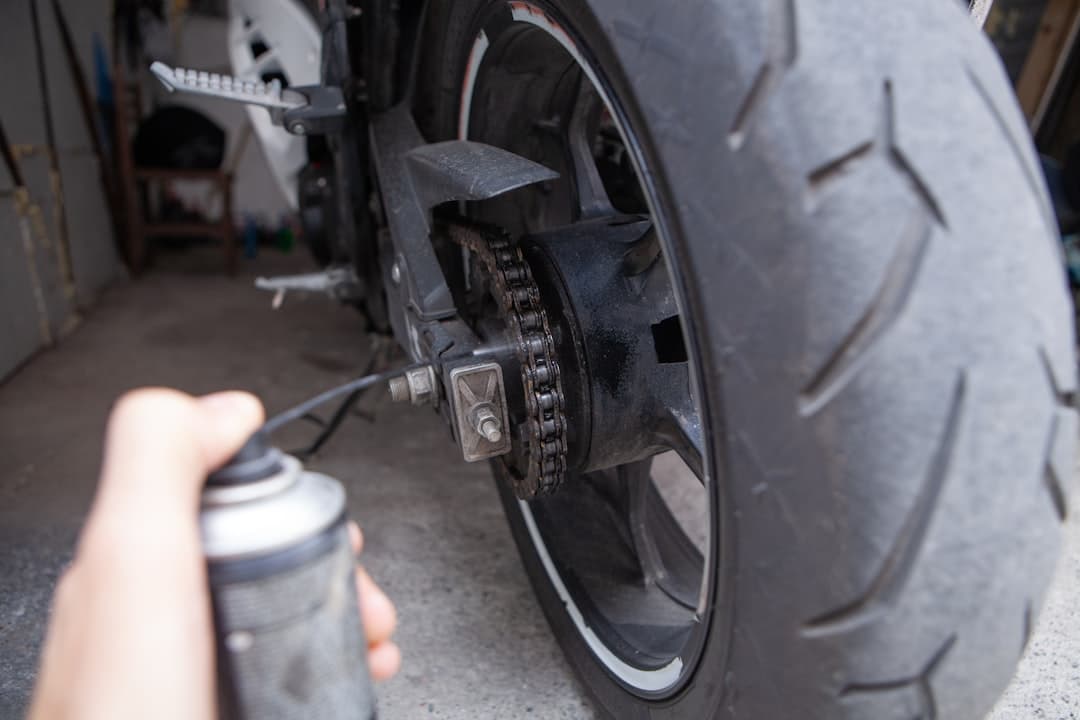
Hold the cardboard behind the chain to protect your wheel and swingarm. Spray the chain cleaner generously on the section you can see — the bottom run of the chain between the sprockets.
Let it sit for 30-60 seconds. The solvent needs time to break down the grime.
Step 3: Scrub with the Brush
Use the chain brush on the section you sprayed. A 3-sided grunge brush cleans the top, bottom, and sides of the chain in one pass. Scrub firmly but don't go insane — you're removing grime, not metal.
Step 4: Rotate and Repeat
Spin the wheel (or roll the bike) to expose the next section of chain. Spray, wait, scrub. Continue until you've cleaned the entire chain — roughly one full rotation of the wheel.
Step 5: Wipe Down
Run a clean rag along the chain to remove loosened grime and excess cleaner. The chain should look clean and metallic — not caked with black grease.
Step 6: Apply Chain Lube
Wait 5-10 minutes for the cleaner to evaporate. Applying lube over wet cleaner dilutes the lube and reduces its effectiveness.
Apply lube to the inside of the chain (the side that contacts the sprockets). Spray a thin, steady line while slowly rotating the wheel. One full rotation is enough — you don't need to drown it.
Target the O-rings and the rollers. That's where the lube does its job — keeping the sealed grease inside the links and reducing friction between the chain and sprockets.
Step 7: Let It Set
After lubing, let the bike sit for 10-15 minutes before riding. This lets the lube penetrate into the links and become tacky. Riding immediately flings fresh lube off the chain and onto your wheel and swingarm.
Lube your chain the night before you ride, not right before. Applying lube the evening before gives it all night to set and penetrate. By morning, the excess has dripped off and the remaining lube is exactly where it needs to be.
How to Check Chain Tension
Chain tension should be checked every time you clean and lube. An improperly tensioned chain accelerates wear and can be dangerous.
Finding the Spec
Your owner's manual lists the correct chain slack measurement. It's typically measured at the midpoint of the bottom chain run (between the front and rear sprockets) and is usually between 20-35mm (roughly 0.8-1.4 inches) of vertical play. Every bike is different — check your manual.
Measuring
- Put the bike on a level surface.
- Find the midpoint of the lower chain run.
- Push the chain up with your finger and measure the distance it moves. Then push it down and measure again. The total vertical movement is your chain slack.
Adjusting
If the chain is too loose or too tight:
- Loosen the rear axle nut (don't remove it — just loosen enough to allow the wheel to slide).
- Use the chain adjuster bolts on each side of the swingarm to push the wheel forward (less slack) or backward (more slack).
- Adjust both sides equally. Count the turns on each adjuster bolt. Uneven adjustment misaligns the wheel, which destroys chains and tires.
- Re-torque the axle nut to spec (check your manual — typically 60-90 ft-lbs).
- Re-check the slack after tightening.
A too-tight chain is more dangerous than a too-loose chain. Over-tightened chains put extreme stress on the output shaft bearing, the swingarm pivot, and the chain itself. When the suspension compresses over bumps, a tight chain gets even tighter and can snap. Always err slightly loose rather than tight.
When to Replace Your Chain
Even with perfect maintenance, chains wear out. Here's how to know when it's time:
The Chain Stretch Test
Chains don't actually stretch — the internal pins and bushings wear, increasing the distance between links. This "stretch" means the chain no longer meshes properly with the sprockets.
How to check: Pull the chain away from the rear sprocket at the 3 o'clock position. If you can pull it far enough to see more than half the sprocket tooth, the chain is stretched and needs replacement.
Visible Wear Signs
- Stiff links: Roll the bike slowly and watch the chain wrap around the sprockets. Any links that don't bend smoothly are seized and the chain is done.
- Rust that won't clean off: Surface rust is cosmetic. Deep rust that pitting the metal means structural weakness.
- Kinked chain: If the chain doesn't hang in a smooth curve when the bottom run is slack, it's worn unevenly.
Sprocket Inspection
Always replace the chain AND sprockets together. A new chain on worn sprockets (or vice versa) will destroy the new component within a few thousand miles. The teeth should be symmetrical and flat on top. Hooked, pointed, or shark-fin shaped teeth = worn out.
Replacement Costs
| Component | Cost (Parts) | Cost (Shop Labor) |
|---|---|---|
| Chain only | $50-150 | $80-150 |
| Front sprocket | $15-30 | Included with chain |
| Rear sprocket | $30-80 | Included with chain |
| Complete chain + sprocket kit | $100-250 | $80-150 |
A chain and sprocket replacement is one of the easier shop jobs — most places can do it in under an hour. Or, if you're handy, it's a solid Saturday garage project with basic tools.
Chain Lube: Types and What to Use
Wax-Based Lube
Dries to a waxy film. Doesn't fling as much, doesn't attract as much dirt, and keeps the chain cleaner between services. Slightly less water resistant than wet lubes.
Best for: Street riding, commuting, dry climates.
Wet/Petroleum-Based Lube
Stays wet and tacky. Better water resistance and penetration into the links. Attracts more dirt and flings more at high speed.
Best for: Touring, rain riding, wet climates.
Our Recommendation
For most riders, a wax-based lube is the better choice. It keeps the chain cleaner, flings less onto your wheel, and performs well in all conditions except sustained heavy rain. Motul C4 Chain Lube and Maxima Chain Wax are two of the most popular wax-based options.
The 15-Minute Chain Routine
Here's the condensed version for your garage wall:
- Park bike, let chain cool to warm (not hot)
- Spray cleaner on chain, wait 60 seconds
- Scrub with brush
- Rotate wheel, repeat until full loop is clean
- Wipe with rag
- Wait 5-10 minutes for cleaner to evaporate
- Apply lube to inside of chain, one full rotation
- Check tension (20-35mm slack at midpoint)
- Let lube set 10+ minutes before riding
Do this every 300-600 miles and your chain will last 20,000+ miles. Skip it and you'll be buying a new chain at 8,000 miles. The math is simple. While you're at it, keep your oil fresh and your tires in good shape — they're the other two maintenance tasks that make the biggest difference.
Frequently Asked Questions
How often should you lube a motorcycle chain?
You should clean and lube your motorcycle chain every 300-600 miles, or immediately after riding in rain or dusty conditions. If you commute daily, that works out to roughly every two weeks.
Can you use WD-40 on a motorcycle chain?
No, never use WD-40 on a motorcycle chain. WD-40 is a solvent that destroys the O-rings that seal grease inside the chain links. Always use a cleaner specifically labeled as O-ring safe, such as Motul chain cleaner.
How do I know when my motorcycle chain needs replacing?
Pull the chain away from the rear sprocket at the 3 o-clock position. If you can see more than half the sprocket tooth, the chain is stretched and needs replacement. Also check for stiff links, deep rust, or visible kinking.
How long does a motorcycle chain last?
A well-maintained motorcycle chain lasts 15,000 to 25,000 miles. A neglected chain may only last 5,000 to 8,000 miles and will also damage your sprockets, turning a simple maintenance task into a more expensive repair.
Should I replace motorcycle chain and sprockets at the same time?
Yes, always replace the chain and both sprockets together. A new chain on worn sprockets or new sprockets on a worn chain will cause the new component to wear out prematurely, often within just a few thousand miles.
Written by
6FOOT4HONDAMotorcycle creator with 1.2M+ subscribers on YouTube and 2M+ across all platforms. Riding and filming since 2016, with 1,000+ videos covering beginner riding tips, gear reviews, stunts, and road trips. Every product recommended on this site has been personally tested on real rides — from highway touring to track days to stunt sessions. Based in the US, riding year-round.
Related Articles
Motorcycle Maintenance for Beginners: The Complete Guide (2026)
Everything you need to know about maintaining your motorcycle - chain care, tires, cleaning, storage, security, and the real cost of ownership. Your complete maintenance hub.
How to Change Motorcycle Oil: Step-by-Step Guide for Beginners (2026)
Change your motorcycle oil in 30 minutes with basic tools. Step-by-step instructions, what oil to use, how often to change it, and the tools you need.

How to Clean Your Motorcycle: The Complete Wash and Detail Guide
The step-by-step guide to washing, detailing, and protecting your motorcycle — without scratching the paint, frying electronics, or spending all day doing it.