Motorcycle Insurance for Beginners: What You Actually Need (2026)
By 6FOOT4HONDA · 13 min read · Mar 3, 2026 · Updated Mar 4, 2026
This post may contain affiliate links. We only recommend gear we'd use ourselves. If you click a link and make a purchase, we may earn a small commission at no extra cost to you.
In This Article
Motorcycle insurance for beginners costs $400-$3,000 per year depending on age, bike type, and coverage. At minimum, carry liability coverage of 50/100/50 and uninsured motorist coverage. Add collision and comprehensive if your bike is worth over $5,000 or is financed. Get quotes from at least four insurers before buying.
Motorcycle insurance is the most confusing part of buying your first bike — and the most expensive ongoing cost most new riders don't plan for. A 21-year-old rider on a Ninja 500 can pay anywhere from $500 to $3,000 per year depending on coverage, location, and the choices they make during the quote process.
Most beginners either over-insure (paying $200/month for a $4,000 bike) or under-insure (state minimum liability on a sport bike with no medical coverage). Both are expensive mistakes — one costs you monthly, the other costs you everything when a car turns left in front of you.
This guide explains what each coverage type actually does, which ones you need, and how to get your rate as low as possible.
The Coverage Types (What They Actually Mean)
Liability (Required in Every State)
What it covers: Damage and injuries you cause to OTHER people and their property. If you rear-end a car, your liability pays for their car repair and their medical bills. It does NOT cover you or your bike.
How it's written: 25/50/25 means $25,000 per person bodily injury / $50,000 per accident bodily injury / $25,000 property damage.
What you need: Your state's minimum is the legal floor, not a recommendation. State minimums are usually laughably low (like 25/50/25). A single ER visit exceeds $25,000 easily. If you cause more damage than your liability limit, you pay the difference out of pocket. They will sue you.
Recommendation: Get at least 50/100/50 if you can. 100/300/100 is ideal but more expensive. This is the one coverage where higher limits are always worth it.
Collision
What it covers: Damage to YOUR motorcycle from a collision with another vehicle or object (car, guardrail, deer, the ground).
How it works: You pay the deductible ($250-$1,000 typically), and insurance pays the rest up to your bike's value.
When it's worth it: If your bike is worth significantly more than the annual cost of collision coverage + your deductible. A $10,000 bike? Collision makes sense. A $2,500 used Ninja 250? You'd pay more in premiums over 2-3 years than the bike is worth.
When to skip it: If the bike is cheap enough that you could replace it out of pocket without financial hardship. Many experienced riders drop collision on older bikes and pocket the savings.
Comprehensive
What it covers: Damage to your motorcycle from non-collision events — theft, vandalism, fire, natural disasters, falling trees, hitting an animal.
How it works: Same deductible structure as collision. You pay the deductible, insurance pays the rest.
When it's worth it: If you park outside (apartments, street parking) where theft is a real risk. Pairing comprehensive coverage with a quality motorcycle lock reduces both your risk and your premium. Also worth it if you live in areas with high vandalism, extreme weather, or deer crossings.
When to skip it: If your bike is garaged, low-value, and you live in a low-crime area.
Comprehensive is usually cheap. Even when collision is expensive (young riders, sportbikes), comprehensive is often only $50-150/year extra because theft and weather claims are less common than crash claims. It's usually worth adding even on lower-value bikes.
Uninsured/Underinsured Motorist (UM/UIM)
What it covers: Your injuries and bike damage when the OTHER driver is at fault but has no insurance (or not enough insurance). This is the most underrated coverage.
Why it matters: About 1 in 8 drivers in the US is uninsured. In some states, it's 1 in 4. If an uninsured driver runs a red light and hits you, without UM/UIM coverage, your medical bills ($50,000-$500,000+ for serious motorcycle injuries) come out of YOUR pocket. You can sue the driver, but uninsured drivers typically have no assets to collect.
Recommendation: ALWAYS carry UM/UIM coverage. It's usually $50-150/year and could save you from financial ruin. Some states require it. Even where optional, get it.
Medical Payments / Personal Injury Protection (MedPay/PIP)
What it covers: Your medical bills regardless of who's at fault. MedPay pays up to a set limit ($5,000-$25,000 typically). PIP is similar but may also cover lost wages and rehabilitation.
When it's worth it: If you don't have health insurance or your health insurance has a high deductible. MedPay pays before your health insurance and covers the deductible.
When to skip it: If you have good health insurance with a low deductible, MedPay may be redundant.
Accessory Coverage
What it covers: Aftermarket parts and accessories — exhaust, crash bars, luggage, GPS, windscreen. Standard policies only cover the bike at its stock value.
When it's worth it: If you've put significant money into modifications. A $3,000 exhaust system isn't covered under a standard policy unless you add accessory coverage.
What Coverage Do You Actually Need?
Here's a simplified guide based on your situation:
| Your Situation | Recommended Coverage |
|---|---|
| Financed bike (lender requires full coverage) | Liability (50/100/50+), Collision, Comprehensive, UM/UIM |
| Owned outright, bike worth $5,000+ | Liability (50/100/50+), Collision, Comprehensive, UM/UIM |
| Owned outright, bike worth $2,000-5,000 | Liability (50/100/50+), Comprehensive, UM/UIM. Skip collision. |
| Owned outright, bike worth under $2,000 | Liability (50/100/50+), UM/UIM. Skip collision and comp. |
If your bike is financed or leased, your lender REQUIRES full coverage (liability + collision + comprehensive). You don't have a choice. They own the bike until you pay it off, and they want their asset protected. Dropping collision or comprehensive will violate your loan agreement.
How Insurance Companies Set Your Rate
Understanding what drives your premium helps you control it.
Factors That Raise Your Rate
- Age: Under 25 = highest rates. Under 21 = astronomical rates. Insurance companies consider young riders high-risk regardless of actual skill.
- Bike type: Sportbikes and supersports cost 2-4x more to insure than cruisers, standards, and dual-sports of the same value. A $6,000 Ninja 650 costs more to insure than a $6,000 Rebel 500. Insurers have decades of crash data proving sportbike riders file more claims.
- Engine size: Bigger engine = higher rate. A 1000cc sportbike can be 3-5x the insurance cost of a 400cc sportbike.
- Location: Urban areas with more traffic, theft, and uninsured drivers cost more than suburban or rural areas.
- Riding history: Tickets, accidents, and claims on your driving record increase rates significantly. A single at-fault accident can double your premium.
- Credit score: In most states, insurers use credit-based insurance scores. Lower credit = higher premiums.
- No prior motorcycle insurance: If you've never had a motorcycle policy, you'll pay more than someone with continuous coverage history.
Factors That Lower Your Rate
- MSF course completion: 10-15% discount at most insurers. Bring your completion card when you get a quote.
- Multi-policy bundling: Bundle motorcycle + auto + renters with the same company for 10-25% savings.
- Anti-theft devices: A disc lock, alarm, or GPS tracker can earn a 5-10% discount. Mention them when quoting.
- Higher deductibles: Raising your collision deductible from $250 to $1,000 can drop your premium by 20-30%. Just make sure you can afford the deductible if you need it.
- Seasonal coverage: Some insurers offer "lay-up" policies where you suspend collision and comprehensive during months you don't ride (winter). This can save 15-25%.
- Paying annually: Monthly payments include fees. Paying the full annual premium upfront saves $50-100/year at most insurers.
- Clean driving record: After 3-5 years with no tickets or claims, your rate drops significantly.
- Garage storage: A garaged motorcycle has lower theft and weather damage risk. Some insurers ask and give a discount.
How to Get the Cheapest Rate
Step 1: Get Multiple Quotes
Never accept the first quote. Rates for the exact same coverage can vary by 50-100% between companies. Get quotes from at minimum:
- Progressive — Consistently competitive for motorcycle insurance, especially for sportbikes and younger riders
- GEICO — Strong rates for riders with clean records
- Dairyland — Specializes in motorcycle insurance, good for riders who've been turned down elsewhere
- Your current auto insurer — Multi-policy discounts can make them competitive even if their base motorcycle rate is higher
- Markel / Foremost — Specialty motorcycle insurers that sometimes beat the big names
Get all quotes on the same day with the same coverage levels so you're comparing apples to apples.
Step 2: Adjust Your Coverage Intelligently
Use the coverage guide above. Don't pay for collision on a $2,000 bike. Don't skip UM/UIM to save $10/month. Find the right balance for your specific situation.
Step 3: Take the MSF Course
If you haven't already, the insurance discount alone usually pays for the course within the first year.
Step 4: Choose Your First Bike Strategically
If insurance cost matters to you (and it should, especially for younger riders), your bike choice has a massive impact:
| Bike | Typical Annual Insurance (21-year-old, clean record) |
|---|---|
| Honda Rebel 500 | $400-800 |
| Kawasaki Ninja 500 | $600-1,200 |
| Yamaha MT-07 | $600-1,400 |
| Kawasaki Ninja 650 | $800-1,800 |
| Yamaha R7 | $1,200-2,500 |
| Honda CBR600RR | $2,000-4,000+ |
The difference between a Rebel 500 and a CBR600RR can be $2,000+ per year in insurance alone. That's a significant cost most new riders don't consider when choosing their first bike.
Get insurance quotes BEFORE you buy the bike. You might fall in love with a Yamaha R7 and then discover the insurance costs more per year than the bike payment. Know the full cost of ownership — bike payment + insurance + gear + maintenance — before you commit.
Filing a Claim: What to Expect
If you crash or your bike is stolen:
- Call 911 if there are injuries or the road is blocked. Get a police report. This is critical for your claim.
- Document everything at the scene. Photos of all vehicles, damage, road conditions, license plates, and witness contact info.
- Call your insurance company within 24 hours. Most have 24/7 claim lines and apps.
- Don't admit fault at the scene. Don't apologize, don't say "it was my fault." Just exchange information and let the insurance companies sort liability.
- Get a copy of the police report. Your insurance company will request it.
- If the bike is damaged, get estimates from motorcycle-specific shops. Not general auto body shops.
- If the bike is totaled, the insurer will offer you the actual cash value (ACV) — what the bike was worth before the crash, not what you paid for it or what it costs to replace. This is often lower than expected. You can negotiate by providing comps (similar bikes for sale in your area).
Common Beginner Mistakes
- Riding without insurance — One crash and you could owe $100,000+ in medical bills and property damage. It's also illegal in every state.
- State minimum liability only — A $25,000 liability limit won't cover a serious injury. You'll be personally liable for the rest.
- Skipping UM/UIM — The coverage that protects you from other drivers' mistakes. It's cheap. Get it.
- Not shopping around — The first quote is almost never the best quote.
- Choosing a bike based on cool factor without checking insurance cost — A 600cc supersport can cost $3,000+/year to insure for a young rider. That's $250/month on top of your bike payment.
If you're brand new to motorcycles, start with our complete beginner's guide to motorcycles for the full roadmap. Then check out our beginner motorcycles guide to see which bikes are insurance-friendly, and our used motorcycle buying guide if you're buying used (which is often cheaper to insure than new).
Frequently Asked Questions
How much does motorcycle insurance cost for a beginner?
Motorcycle insurance for a beginner typically costs $500 to $3,000 per year depending on your age, bike type, location, and coverage level. A 21-year-old on a cruiser like a Rebel 500 might pay $400-800 per year, while the same rider on a CBR600RR could pay $2,000-4,000 or more.
What type of motorcycle insurance do I need?
At minimum, you need liability coverage of at least 50/100/50 and uninsured motorist coverage. If your bike is worth over $5,000 or is financed, add collision and comprehensive. Comprehensive is usually cheap at $50-150 per year and covers theft, vandalism, and weather damage.
Why is motorcycle insurance so expensive for sportbikes?
Sportbikes cost 2-4 times more to insure than cruisers or standards because insurance companies have decades of crash data showing sportbike riders file significantly more claims. Larger engines also increase rates, so a 1000cc sportbike can cost 3-5 times more to insure than a 400cc model.
What is uninsured motorist coverage for motorcycles?
Uninsured motorist coverage pays for your injuries and bike damage when another driver is at fault but has no insurance or not enough insurance. About 1 in 8 US drivers is uninsured, and this coverage typically costs only $50-150 per year while protecting you from potentially catastrophic medical bills.
How can I lower my motorcycle insurance rate?
Complete an MSF safety course for a 10-15 percent discount, bundle with your auto insurance for 10-25 percent savings, raise your deductible, get quotes from at least 4-5 companies, and choose an insurance-friendly bike like a standard or cruiser instead of a supersport.
Written by
6FOOT4HONDAMotorcycle creator with 1.2M+ subscribers on YouTube and 2M+ across all platforms. Riding and filming since 2016, with 1,000+ videos covering beginner riding tips, gear reviews, stunts, and road trips. Every product recommended on this site has been personally tested on real rides — from highway touring to track days to stunt sessions. Based in the US, riding year-round.
Related Articles
The Real Cost of Owning a Motorcycle: Everything Beyond the Sticker Price (2026)
Insurance, gear, tires, maintenance, fuel — the complete annual breakdown of what motorcycle ownership actually costs. The number is higher than you think.
Best Motorcycles for Women 2026
14 bikes ranked by seat height, weight, and fit. Includes the inseam-to-seat chart nobody else has and the gatekeeping myths you need to ignore.
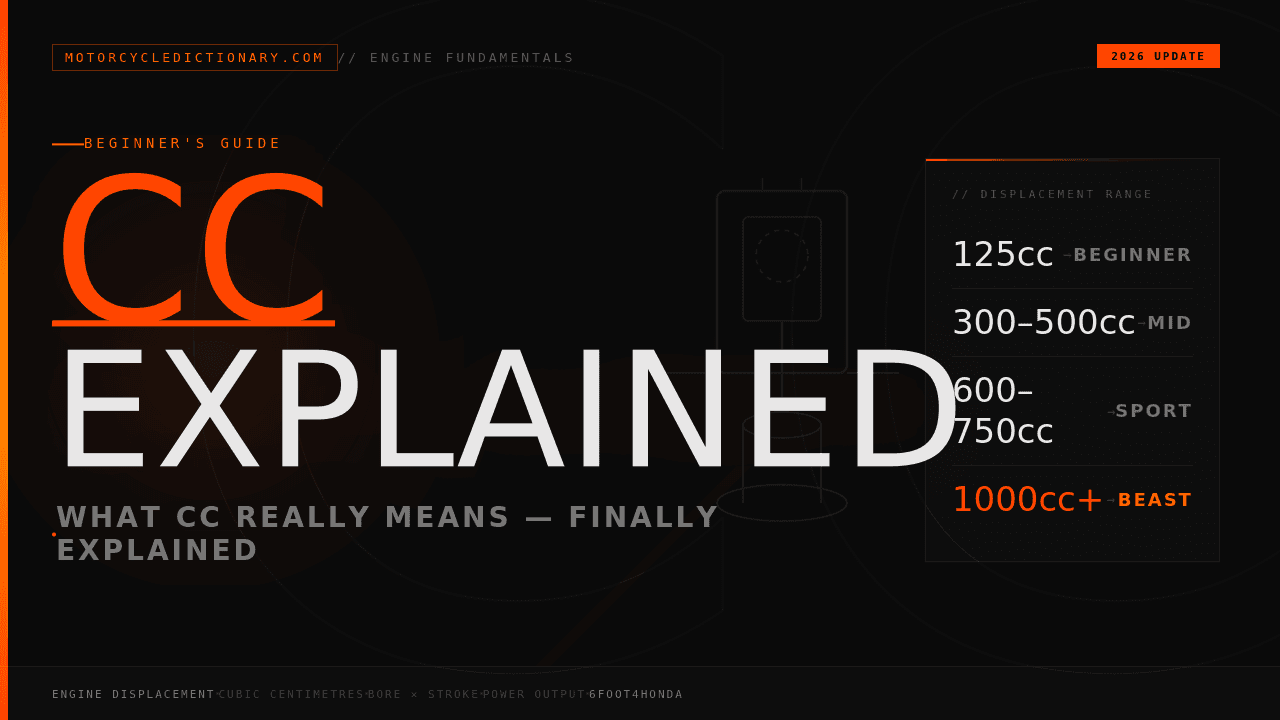
Motorcycle CC Explained (What It Means)
CC measures engine displacement, not speed. Here's what it actually means, why a 650cc cruiser feels nothing like a 650cc sportbike, and what CC to start on.