This post may contain affiliate links. We only recommend gear we'd use ourselves. If you click a link and make a purchase, we may earn a small commission at no extra cost to you.
In This Article
The best motorcycle riding shoe is the TCX Street 3 WP ($190 retail, currently $95-$110 on closeout) — CE EN 13634 certified with D3O ankle armor, T-Dry waterproof membrane, and it legitimately looks like a normal sneaker. For maximum waterproof protection, the SIDI Gavia Gore ($250-$273) uses GORE-TEX and is built for all-weather touring. On a tight budget, the Icon Tarmac WP ($150) packs D3O armor and an eVent membrane at the lowest price in the category.
Motorcycle riding shoes are a legitimate option for urban commuting and short rides under 45 mph. They protect your ankles with CE-rated armor while looking normal enough to wear all day. Budget $100-$250 for a quality pair with ankle protection and a shift pad. If you can only own one piece of foot protection, buy boots — but if you want daily-rideable convenience, a proper riding shoe beats your sneakers by infinity percent.
All right so let me tell you something — I used to ride in Vans. Regular old skate shoes. No ankle protection, no armor, nothing. Then I lowsided at like 25 mph and my ankle swelled up like a tennis ball. Couldn't walk right for weeks. And that was a low-speed crash on a neighborhood street, not even highway speed. The first thing that hits the ground in a lowside is your foot and ankle because your leg gets pinned under the bike as it slides. I was lucky it wasn't broken.
After that I went full boots for a while — which are great, don't get me wrong — but then I started looking into riding shoes because I needed something I could actually walk around in at work and not look like I was about to go rock climbing. Turns out the riding shoe market in 2026 is insane. D3O ankle armor, waterproof membranes, CE certifications — all packed into shoes that look like normal sneakers. So here's everything I've tested and what's actually worth your money.
If you want full boots instead, check our best motorcycle boots for beginners guide. This article is specifically about riding shoes — the low-cut, sneaker-style, walk-around-all-day options.
When Are Motorcycle Riding Shoes Actually Enough?
This is the question nobody answers properly. Every article just lists products without telling you WHEN shoes are appropriate and when you genuinely need boots. Here's the honest breakdown.
Shoes are fine for:
- Urban commuting under 45 mph
- Short trips — errands, coffee runs, meeting a buddy
- When you need to walk all day after riding (campus, office, shopping)
- Warm weather when full boots cause your feet to melt
- Scooter and small displacement city riding
You need boots for:
- Track days (no exceptions — track organizations require over-ankle boots)
- Off-road and adventure riding
- Long-distance touring at sustained highway speeds
- Rain and cold weather (shoes have an ankle gap that lets water in)
- Two-up riding (more weight = longer stops = more risk)
- Highway riding above 55 mph regularly
- New riders still dropping the bike (boots protect pinned ankles better)
The honest answer: Own both. Shoes for daily life, boots for serious rides. If you can only afford one, buy boots. If you already have boots and want a convenient daily option, this is where riding shoes shine.
What Makes a Riding Shoe Different From Regular Sneakers?
Let me tell you, the difference is not subtle. Even a basic CE-rated riding shoe has five protection features that your Air Jordans don't:
1. Ankle Armor — The big one. Riding shoes have malleolus protectors on both sides of the ankle — those bony bumps that take the first impact in any slide or drop. Technologies include:
- D3O: Viscoelastic material that's soft and flexible normally but stiffens on impact. 41% thinner and 38% lighter than standard guards. Used in TCX and Icon shoes.
- SEESOFT (REV'IT): Injected disc armor contoured to the malleolus shape.
- Dual-density (Alpinestars): Soft inner layer for comfort + hard outer layer for impact absorption.
- Rigid inserts (Dainese): Traditional hard protectors placed at ankle points.
2. Toe Box Reinforcement — Protects against crush injuries when the bike lands on your foot in a lowside. Missing on some cheaper options including the Dainese York — which is a significant safety gap at $200.
3. Heel Cup — A rigid heel cup that deflects force away from your heel bone. This is often the first impact point when your foot catches pavement.
4. Shift Pad — A reinforced area on top of the toe where the shift lever contacts the shoe. Without it, the lever chews through material in a few weeks. If your shoe doesn't have one, a clip-on external shift pad costs $10-15.
5. Abrasion-Resistant Upper — Leather or synthetic uppers that actually survive sliding across asphalt instead of evaporating on contact like canvas or standard leather sneakers.
Material ranking for abrasion resistance:
| Material | Slide Resistance | Examples |
|---|---|---|
| Full-grain leather | Best — slides without tearing | TCX Dartwood, Forma, SIDI |
| Microfiber/synthetic | Nearly as good, lighter, no maintenance | Alpinestars, SIDI |
| Suede | Less resistant, wears faster | Some REV'IT models |
| Canvas/textile | Lowest — inadequate for highway | Avoid for riding |
What Does the CE EN 13634 Label Actually Mean?
Every riding shoe throws around "CE certified" but nobody explains what those numbers actually mean. Here's the deal.
The EN 13634:2017 standard tests motorcycle footwear on four criteria. Each gets a Level 1 (basic) or Level 2 (superior) rating:
| Test | Level 1 | Level 2 | What It Means |
|---|---|---|---|
| Upper Height | Minimum ankle coverage | Higher coverage | How much of your ankle is protected |
| Impact Abrasion | Survives 5 seconds of grinding | Survives 12 seconds | 2.4x longer slide protection at L2 |
| Impact Cut | <25mm blade penetration | <15mm penetration | 40% less penetration at L2 |
| Transverse Rigidity | Resists 225 lbs of crush force | Resists 337 lbs | 50% more crush resistance at L2 |
Additional optional marks you might see: WR (waterproof tested), SRB (slip resistance), IPA (ankle impact protection).
A shoe labeled 2-2-2-2 is as good as it gets. A shoe labeled 1-1-1-1 still beats your Air Jordans by infinity percent. When shopping, at minimum look for a shoe that passes EN 13634 at any level — that guarantees a baseline of real protection.
If a shoe doesn't mention CE EN 13634 certification at all, it's a fashion item with motorcycle branding. Real protection requires real testing. Don't spend $200 on a "motorcycle shoe" that hasn't been certified.
What Are the Best Casual Motorcycle Riding Shoes?
These are the shoes that look like normal sneakers but actually protect your ankles. The ones you can ride to work in and nobody knows.
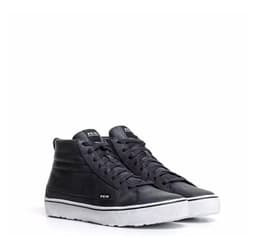
TCX Street 3 WP
D3O ankle armor, T-Dry waterproof membrane, CE EN 13634 certified. Currently on closeout at $95-$110 — insane value for this level of protection.
The TCX Street 3 WP is the one I tell everyone to buy right now and there's a specific reason — it's on closeout. The retail price is $190 which is already competitive, but you can find them for $95-$110 which is absolutely bonkers for what you get. D3O malleolus armor on both sides, a T-Dry waterproof membrane that actually works in rain, reinforced shift pad, and a Groundtrax rubber sole with genuine grip on wet pavement. They're comfortable enough to walk in all day and they look like normal high-top sneakers. The closeout won't last forever so if you're reading this and they're still available at that price, just cop them.
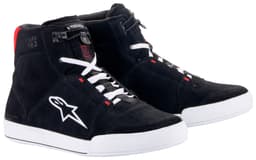
Alpinestars Chrome
Premium street style with dual-density internal ankle armor. Sleek design that genuinely passes as a fashion shoe. No waterproof membrane in the base model.
The Alpinestars Chrome ($220) is the best-looking riding shoe on this list. If aesthetics matter to you — and I get it, nobody wants to walk around in ugly shoes — this is the one. Dual-density internal ankle armor, CE EN 13634 certified, and a design that legitimately looks like a high-end street shoe. The trade-off is no waterproof membrane in the base model (the Drystar variant adds $20-30 for water resistance). If you ride in dry weather most of the time and want something that looks fire both on and off the bike, this is the move.
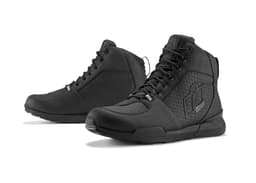
Icon Tarmac WP
D3O ankle armor plus hard protector, eVent waterproof membrane — the best membrane technology in this price range. $150 makes this the budget pick that doesn't feel budget.
The Icon Tarmac WP ($150) is the sleeper pick bro. D3O ankle armor PLUS an external hard protector for double the impact protection, and an eVent membrane which is arguably better than most competitors' waterproofing at this price. eVent is more breathable than most WP membranes so your feet don't turn into swamp ponds on hot days. At $150 it undercuts the competition by $40-70 while matching or beating their protection specs. If you're budget-conscious but don't want to compromise on safety, this is the one.
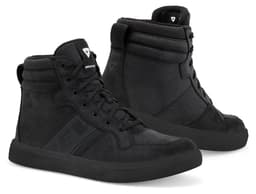
REV'IT Kick
Skateboard-inspired design with SEESOFT injected ankle armor. Currently on closeout around $159. The most casual-looking shoe on this list.
The REV'IT Kick ($199, closeout ~$159) looks the most like a regular sneaker of anything on this list. It's basically a reinforced skate shoe with SEESOFT injected disc armor at the ankle points. If you want something that absolutely nobody would guess is motorcycle gear, this is it. The catch is no waterproof membrane — this is a dry-weather shoe. But for commuters in California or Arizona who never see rain, it's perfect.
What Are the Best Sport Motorcycle Riding Shoes?
For riders who want more aggressive styling and slightly more protection than casual shoes.
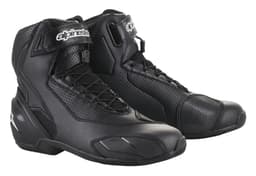
Alpinestars SP-1 v2
External TPR ankle protectors, Cat 2 CE certified, aggressive sport design. The go-to for sportbike riders who don't want full race boots.
The Alpinestars SP-1 v2 ($200) is built specifically for sportbike riders. External TPR ankle protectors give it more robust impact protection than internal-only designs, and the Cat 2 CE certification puts it at the top of the protection hierarchy for shoes. Vented for airflow with no waterproof membrane — this is a dry-weather, performance-focused shoe. Not the most walkable option off the bike, but on the bike it offers the most confidence of any shoe-height option.
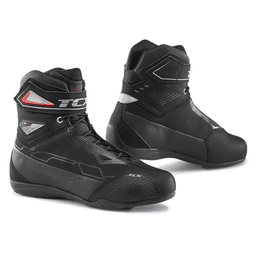
TCX Rush 2 WP
Sport commuter crossover with T-Dry waterproof membrane. On closeout at $90-$120 — potentially the best value motorcycle shoe you can buy right now.
The TCX Rush 2 WP ($160 retail, closeout $90-$120) is honestly ridiculous value. CE EN 13634 certified, malleolus guards on both sides, T-Dry waterproof membrane, and sport-styled looks — for potentially under $100 on closeout. If you can find these in your size at that price, buy them immediately. The Rush 2 bridges the gap between casual and sport better than anything else on the market.
What Are the Best Waterproof Motorcycle Riding Shoes?
For riders in the Pacific Northwest, UK, or anywhere you're riding in rain more often than not.
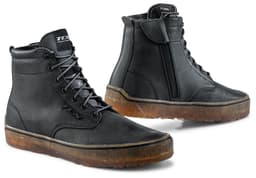
TCX Dartwood WP
Full-grain leather upper, D3O malleolus armor, T-Dry waterproof membrane. Heritage styling that works with jeans or chinos. The best all-around riding shoe if money isn't the top priority.
The TCX Dartwood WP ($210) is the shoe I'd buy if I could only own one pair. Full-grain leather that ages beautifully, D3O ankle armor, T-Dry waterproofing, and a heritage aesthetic that genuinely looks great off the bike. The leather upper provides the best abrasion resistance of any shoe on this list — if you go down, full-grain leather slides without tearing while synthetic materials can grab and bunch. The $210 price is justified by the material quality and protection level. This is a buy-it-for-years shoe.
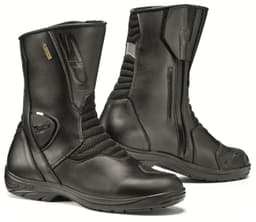
SIDI Gavia Gore
GORE-TEX membrane — the gold standard of waterproofing. PU ankle pads, Italian build quality. The best waterproof motorcycle shoe you can buy.
The SIDI Gavia Gore ($250-$273) uses a GORE-TEX membrane which is the gold standard of waterproofing — nothing else keeps water out as effectively while remaining breathable. CE EN 13634 certified with PU ankle pads. This is an Italian-made shoe built to last years of all-weather commuting. The price is steep but GORE-TEX earns its premium in monsoon season. If you ride year-round in the rain, this is the one.
How Do You Get the Right Size in Motorcycle Shoes?
Sizing is where a lot of people get burned, especially ordering online. Here are the tips that'll save you a return.
Italian brands run narrow. TCX, SIDI, Dainese, Forma — all Italian, all cut for narrower feet. If you have wide feet, go up a half to full EU size. I have wide feet and I learned this the hard way after trying to cram my foot into a SIDI that technically matched my size chart measurement.
Sport shoes run small. The stiffer construction and armor take up internal space. When in doubt between sizes, go up one EU size.
Measure at the end of the day. Your feet swell throughout the day, and they'll swell more while riding (heat from the engine, reduced blood flow from the riding position). Your evening measurement is your riding size.
Wear thin moisture-wicking socks. Not cotton. Cotton absorbs sweat and bunches up, making the fit inconsistent. A thin synthetic or merino wool sock dramatically improves both comfort and fit consistency. This is a small thing that makes a huge difference on long rides.
Leather breaks in — synthetic doesn't. Full-grain leather shoes (TCX Dartwood, SIDI) will feel tight for the first 3-5 rides then mold to your foot. Synthetic shoes (Alpinestars, Icon) feel the same on day 1 and day 100.
The shift test. Before committing, sit on your bike and try the shifting motion. Your toe must fit under the shift lever comfortably. Some shoes with bulky toe boxes make upshifts awkward — better to find out at home than after you've cut the tags off.
If you're ordering online, buy two sizes and return one. Most retailers offer free returns. It's way better than forcing yourself to ride in shoes that don't fit right. Bad-fitting riding shoes cause blisters, hot spots, and distraction — none of which you want while riding.
Quick Comparison: All Riding Shoes at a Glance
| Shoe | Price | CE Rating | Ankle Armor | Waterproof | Best For |
|---|---|---|---|---|---|
| TCX Street 3 WP | $95-$110 (closeout) | EN 13634 | D3O | T-Dry | Urban commuting — BEST VALUE |
| Alpinestars Chrome | $220 | EN 13634 | Dual-density | No (Drystar +$20-30) | Street style |
| Icon Tarmac WP | $150 | D3O rated | D3O + hard protector | eVent | Budget pick |
| REV'IT Kick | ~$159 (closeout) | CE certified | SEESOFT | No | Casual/skate look |
| Alpinestars SP-1 v2 | $200 | Cat 2 CE | External TPR | No (vented) | Sportbike riders |
| TCX Rush 2 WP | $90-$120 (closeout) | EN 13634 | Malleolus guards | T-Dry | Sport commuter |
| TCX Dartwood WP | $210 | EN 13634 L2 | D3O | T-Dry | All-around premium |
| SIDI Gavia Gore | $250-$273 | EN 13634 | PU pads | GORE-TEX | All-weather touring |
Oh by the way guys — if you're looking at shoes because you need something for the whole riding kit, check our motorcycle riding gear complete guide for everything from helmets to gloves. And if you've got wide feet or need women's-specific sizing, our best motorcycle gear for women guide covers women's shoe options including the TCX Lady Street 3. But anyways.
For the full boots rundown when you need more protection, hit our best motorcycle boots for beginners guide.
All right guys that's the full rundown on motorcycle riding shoes. Bottom line — if you're commuting and want something you can walk around in all day, the TCX Street 3 WP on closeout is the best deal in motorcycle gear right now. If closeout is gone, the Icon Tarmac WP at $150 is the best regular-price value. And if you want the buy-it-for-life premium option, the TCX Dartwood WP is the one. Now go protect those ankles. Let's go.
Frequently Asked Questions
Are motorcycle riding shoes worth it?
Can I wear motorcycle riding shoes on the highway?
What CE level do I need for motorcycle shoes?
Do motorcycle shoes run true to size?
What is the difference between motorcycle shoes and motorcycle boots?
How long do motorcycle riding shoes last?
Should I buy waterproof motorcycle shoes?
Can I use regular shoes with a shift pad instead of riding shoes?
Written by
6FOOT4HONDAMotorcycle creator with 1.2M+ subscribers on YouTube and 2M+ across all platforms. Riding and filming since 2016, with 1,000+ videos covering beginner riding tips, gear reviews, stunts, and road trips. Every product recommended on this site has been personally tested on real rides — from highway touring to track days to stunt sessions. Based in the US, riding year-round.
Related Articles
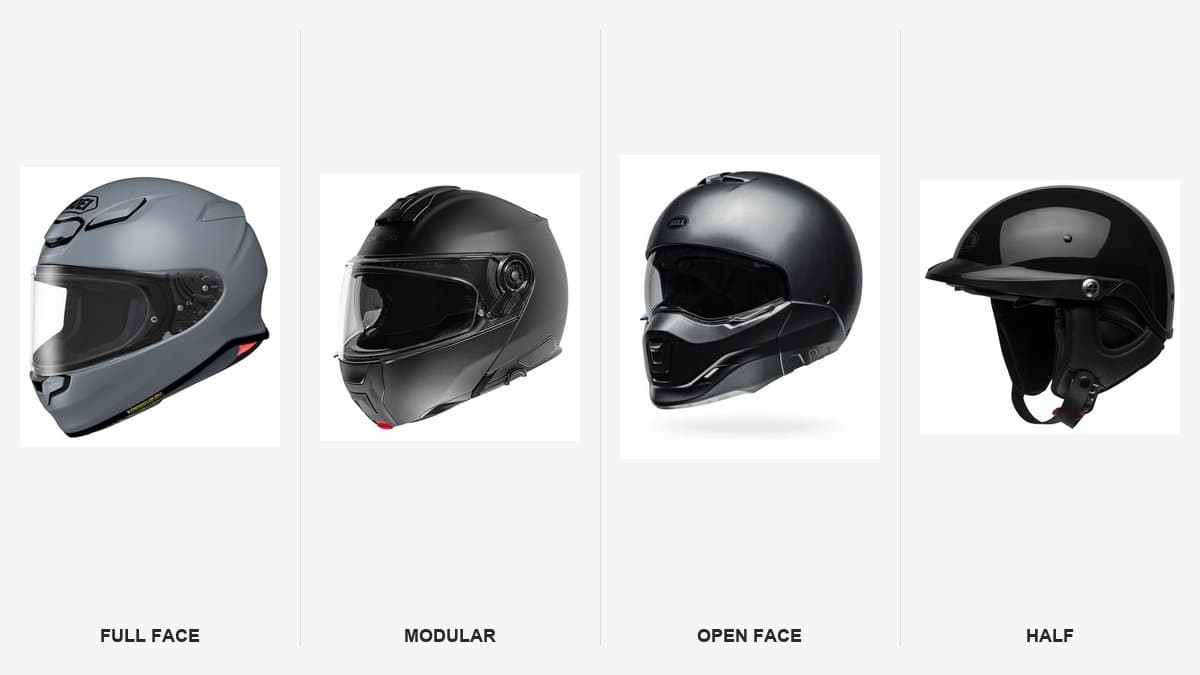
Full Face vs Modular vs Half Helmet 2026
I've worn all 4 helmet types. Full face wins for beginners — here's noise data, safety stats, and top picks.
Best Motorcycle Pants for Beginners 2026 (7 Picks)
The best motorcycle pants for beginners are kevlar riding jeans — they protect like gear and look like regular clothes. 7 picks from $80 to $600.
Best Motorcycle Gear for Women: Helmets, Jackets, Gloves & Boots (2026)
Women's motorcycle gear that actually fits and actually protects. The best helmets, jackets, gloves, pants, and boots designed for women riders — not pink downsized men's gear.