Best Motorcycles for Stunting (9 Bikes Ranked by Budget)
By 6FOOT4HONDA · 16 min read · Mar 5, 2026
This post may contain affiliate links. We only recommend gear we'd use ourselves. If you click a link and make a purchase, we may earn a small commission at no extra cost to you.
In This Article
Picking a stunt bike is not the same as picking a street bike. You are not looking for comfort, top speed, or technology. You are looking for a motorcycle that is cheap to crash, cheap to fix, light enough to throw around, and supported by a deep enough aftermarket that you can bolt on every piece of crash protection and performance hardware you need.
The wrong bike will cost you twice — once when you buy it, and again every time you loop it onto pavement with no crash cage available for your model. The right bike becomes an extension of your body and an investment that holds its value because every other stunt rider wants the same thing.
Here are the 9 best stunt motorcycles in 2026, broken into three budget tiers. If you are just starting out, read our How to Wheelie a Motorcycle guide first.
What Makes a Good Stunt Bike
Before looking at specific models, here are the five things that actually matter:
1. Weight
Lighter is better. Period. When you are at balance point and the bike starts to lean, you need to muscle it back. When you loop and the bike lands on its side, you need to pick it up. When you are doing circles, you are fighting centrifugal force. A 225-pound Grom forgives sloppy technique. A 500-pound Hayabusa punishes it.
2. Cheap and Available Parts
You will break things. Levers, fairings, pegs, handlebars, engine covers, mirrors — all of it eventually hits the ground. The bike you pick should have parts that are cheap, abundant, and quick to ship. Japanese sport bikes from 2000-2010 have the deepest parts availability. European bikes and brand-new models have the worst.
3. Torque Over Horsepower
Horsepower is top-end speed. Torque is what lifts the front wheel. You want strong, predictable torque in the low-to-mid RPM range. Peaky powerband bikes that need 10,000 RPM to make power are harder to control during wheelies because the power comes on suddenly. Linear power delivery is your friend.
4. Aftermarket Support
Crash cages, subcages, 12 o'clock bars, stunt pegs, handbrake kits, sprockets — these are the modifications that make stunting possible and survivable. If nobody makes a crash cage for your bike, you are either fabricating your own or riding without one. Neither is ideal.
5. Riding Position
Upright or slightly forward-leaning positions work best. A bike that puts you in a deep sport tuck (like an R6) makes body position transitions harder. You need to be able to shift your weight freely and quickly between the front and rear of the bike.
Budget Tier: Under $2,500
These are the bikes you learn on. Low consequences, low cost, maximum fun-per-dollar.
1. Honda Grom (MSX125)
Used price: $2,000-$3,500 | Weight: 227 lbs | Engine: 125cc single
The Grom is the greatest stunt training tool ever made. Not because it is the best stunt bike — it is not. Because it is the safest, cheapest, and most forgiving way to learn every fundamental.
At 227 pounds, you can catch a loop with your legs. At 35 mph top wheelie speed, crashing is a parking lot incident, not a highway disaster. Parts cost nothing — a full fairing set is under $100 aftermarket. The engine is bulletproof and will take years of abuse without complaint.
The Grom aftermarket is enormous. Crash cages, subcages, 12 o'clock bars, extended swingarms, rear handbrakes — everything exists. Every stunt rider on social media started on a Grom or wishes they had.
Limitations: The 125cc engine means you will outgrow it for advanced stunts. Power wheelies require first gear and aggressive technique. You cannot really do highway stunts on it. But that is not what the Grom is for. The Grom is for building muscle memory at low speed so that when you move to a bigger bike, the fundamentals are already wired into your brain. For a complete walkthrough on building out a Grom for stunting, see our Honda Grom stunt build guide.
Best for: First-time stunt riders, learning wheelies and stoppies, parking lot practice, content creation.
2. Kawasaki Z125 Pro
Used price: $1,800-$3,000 | Weight: 225 lbs | Engine: 125cc single
The Z125 is the Grom's main competitor, and for stunting purposes, they are nearly identical. Same weight class, same engine size, same concept. The Z125 has slightly different ergonomics (lower seat height, slightly more forward pegs) and some riders prefer its throttle response.
Aftermarket is slightly smaller than the Grom's but still substantial. Most Grom crash cages do not fit the Z125, so make sure you are buying Z125-specific parts.
The decision: Buy whichever one is cheaper and closer to you. They are functionally the same for learning stunts. If both are the same price, the Grom edges out on aftermarket depth.
Best for: Same as the Grom. Pick the cheaper one.
Mid-Budget Tier: $2,500-$5,000
This is where most stunt riders live. Enough power for every stunt, enough aftermarket for full protection, cheap enough that crashing does not ruin your month.
3. Suzuki DRZ400SM
Used price: $3,500-$5,500 | Weight: 322 lbs | Engine: 398cc single
The supermoto king. The DRZ400SM is the most naturally wheelie-prone motorcycle ever sold. The tall seat, narrow frame, light weight, and thumping single-cylinder torque make it want to lift the front wheel. Power wheelies come naturally. The bike practically teaches you.
Supermoto geometry means the DRZ is also incredible for flat-ground stunts — circles, drifts, and transitions between tricks feel intuitive because the bike turns so sharply. The dirt bike chassis absorbs impacts that would crack a sport bike frame.
The DRZ aftermarket is mature: crash cages from Impaktech and others, stunt pegs, handbrake kits, and more. Parts are cheap and the engine is nearly indestructible — the DRZ400 has been in production since 2000 with minimal changes, which means decades of parts supply.
Limitations: The single-cylinder engine runs out of steam for high-speed stunts. You are not doing second-gear power wheelies at 60 mph on a DRZ. The seat height (36.6 inches) is challenging for shorter riders. And the DRZ holds its value aggressively — finding one under $4,000 in good condition takes patience.
Best for: Riders who want one bike for street, stunt, and light dirt. Natural wheelie learners. Riders who prioritize fun-per-dollar.
4. Honda CBR600 F4i (2001-2006)
Used price: $2,500-$4,500 | Weight: 414 lbs | Engine: 599cc inline-4
The legend. The F4i is to stunting what the Stratocaster is to guitar — the default, the standard, the one everyone learns on. There are more stunt F4is in existence than any other stunt bike, and there is a reason for that.
The engine is one of Honda's most reliable inline-fours. It produces smooth, linear power that is predictable and controllable. The fuel injection (post-2001) means no carb tuning. The chassis is stable and forgiving. And because so many F4is have been built, wrecked, and rebuilt over the past 20+ years, parts cost almost nothing. A replacement fairing set is under $300. Engine covers are $15. Levers are $8.
The stunt aftermarket for the F4i is the deepest of any motorcycle. Crash cages from Impaktech, New Breed, Stunt Armor, Sub Cage, and a dozen others. Every stunt part you could ever need exists for this bike.
Limitations: At 414 pounds, it is heavier than the supermoto and mini bikes. The weight is noticeable when you loop and need to pick it up. The inline-4 also does not have the low-end punch of a twin or single — clutch-up technique is essential. And the fairings are fragile (strip them and run a streetfighter look).
Best for: The best value in stunting. If you want one bike to learn everything on, buy a 2003-2006 F4i. This is our top pick for most riders.
5. Honda CB300F / CB300R
Used price: $2,500-$4,000 | Weight: 357 lbs | Engine: 286cc single
The middle ground between a Grom and an F4i. The CB300 is light enough to be forgiving, powerful enough to do real wheelies, and cheap enough that crashing is not a financial crisis.
The single-cylinder engine has good low-end torque for power wheelies. The upright riding position is ideal for stunts. The weight is manageable for most riders. Parts are reasonably priced though the stunt-specific aftermarket is smaller than the F4i or Grom.
Limitations: You will outgrow it faster than an F4i. The 286cc engine is enough for wheelies and stoppies but does not have the power for advanced high-speed stunts. Aftermarket crash protection options are limited compared to the F4i.
Best for: Riders who want something bigger than a Grom but are not ready for a 600. Good stepping stone bike.
6. Kawasaki ZX-636 (2003-2006)
Used price: $3,000-$5,500 | Weight: 407 lbs | Engine: 636cc inline-4
The F4i's aggressive older brother. The 636 makes more power, revs harder, and has a slightly more forward riding position. Where the F4i is predictable and smooth, the 636 is eager and responsive. Both are excellent stunt platforms — the 636 just has a higher ceiling.
The extra 37cc over a standard 600 gives the 636 noticeably more midrange torque, which makes clutch-ups easier and power wheelies more accessible in second gear. The Kawasaki chassis is sharp and responsive.
The 2003-2004 ZX-636 is the sweet spot for stunting. These years have the best combination of price (they are old enough to be cheap), reliability (the engine is proven), and aftermarket support (Impaktech, Woodcraft, and others all make cages for this generation). The 2005-2006 models work too but are typically $500-$1,000 more. Avoid the 2007+ models for pure stunting — they are more expensive and the frame geometry changed.
Limitations: Slightly more aggressive ergonomics than the F4i. The sharper throttle response means a steeper learning curve — it is easier to accidentally loop a 636 than an F4i. Parts are slightly more expensive than Honda equivalents.
Best for: Riders who have basic wheelie skills and want a bike with more headroom for progression. Riders who plan to ride street AND stunt on the same bike.
Performance Tier: $4,000+
These are the bikes that experienced stunt riders graduate to. More power, more capability, higher price tags, and less forgiveness for sloppy technique.
7. Yamaha MT-07 (FZ-07)
Used price: $4,000-$6,500 | Weight: 403 lbs | Engine: 689cc parallel twin
The MT-07 is the modern stunt platform. The 689cc crossplane twin makes absurd torque for its displacement — flat, accessible, and controllable from idle to redline. Power wheelies come naturally in first and second gear. The upright naked bike riding position is perfect for stunting. The weight is competitive with inline-4 sportbikes.
Professional stunt riders have been migrating to the MT-07 because it does everything well. The chassis is nimble, the engine is responsive, and Yamaha's reliability is excellent. The stunt aftermarket is growing rapidly — Impaktech, SubCage, and others all make cages now.
Limitations: More expensive than F4i and 636 options. The stunt aftermarket, while growing, is not as deep as the F4i ecosystem yet. The bike holds its value well, which makes finding cheap ones harder.
Best for: Experienced stunt riders who want a modern platform. Street/stunt dual-purpose riders. Riders who appreciate torque over horsepower.
8. KTM 390 Duke
Used price: $3,000-$5,000 | Weight: 329 lbs | Engine: 373cc single
The KTM 390 Duke is the lightweight precision instrument. At 329 pounds with a punchy single-cylinder engine, it lifts the front with authority and handles like a scalpel. The upright riding position, wide handlebars, and low center of gravity make it intuitive for stunt riding.
The 390 has a loyal stunt following, particularly in Europe and India where KTM singles dominate the market. Aftermarket options exist from manufacturers like CrashBars India and various European fabricators.
Limitations: KTM parts are more expensive than Japanese equivalents. The stunt aftermarket is smaller in the US. Reliability, while improved in recent years, is not quite at Honda or Yamaha levels for high-abuse applications. The single-cylinder engine lacks top-end power for high-speed stunts.
Best for: Riders who want a lightweight, capable stunt bike with European styling. Good for riders transitioning from a Grom/Z125 who want something nimble.
9. Suzuki SV650
Used price: $2,500-$5,000 | Weight: 430 lbs | Engine: 645cc V-twin
The underdog. The SV650's 90-degree V-twin makes gorgeous, tractable torque that is perfect for wheelies. The power delivery is smooth and predictable — arguably the most user-friendly engine character for learning. And SVs are cheap. Really cheap. You can find first-generation (1999-2002) models for under $2,500 all day.
The SV is heavier than most bikes on this list and the stunt aftermarket is smaller, but both generations (first-gen curvy frame, second-gen trellis frame) have crash cage options available. The V-twin sound at balance point is also genuinely special.
Limitations: At 430 pounds, it is the heaviest bike on this list. The weight makes it less nimble for flat-ground tricks. Aftermarket depth is moderate — not terrible, but you will not find 15 crash cage options like you will for an F4i. The V-twin engine layout makes crash cage fitment more complex.
Best for: Riders who want V-twin character on a budget. Riders who prioritize wheelies over flat-ground tricks. Budget-conscious riders who want something bigger than a 300.
Quick Comparison
| Bike | Used Price | Weight | Engine | Aftermarket Depth | Best For |
|---|---|---|---|---|---|
| Honda Grom | $2,000-$3,500 | 227 lbs | 125cc single | Massive | Total beginners |
| Kawasaki Z125 | $1,800-$3,000 | 225 lbs | 125cc single | Large | Total beginners |
| Suzuki DRZ400SM | $3,500-$5,500 | 322 lbs | 398cc single | Large | Natural wheelie feel |
| Honda F4i | $2,500-$4,500 | 414 lbs | 599cc I4 | Massive | Best overall value |
| Honda CB300F/R | $2,500-$4,000 | 357 lbs | 286cc single | Moderate | Stepping stone |
| Kawasaki 636 | $3,000-$5,500 | 407 lbs | 636cc I4 | Large | More power than F4i |
| Yamaha MT-07 | $4,000-$6,500 | 403 lbs | 689cc twin | Growing | Modern platform |
| KTM 390 Duke | $3,000-$5,000 | 329 lbs | 373cc single | Moderate | Lightweight precision |
| Suzuki SV650 | $2,500-$5,000 | 430 lbs | 645cc V-twin | Moderate | V-twin on a budget |
Our Pick: The Honda CBR600 F4i
If you forced us to recommend one bike for most riders, it is the F4i. Not because it is the best at anything — it is not the lightest, not the most powerful, not the cheapest. But it is the best at everything combined. The deepest aftermarket. The cheapest parts. The most proven reliability. The largest community of stunt riders who can help you.
Buy a 2003-2006 F4i with scratches already on it. Budget $400-$600 for a crash cage and subcage. Strip the fairings. Learn everything. Then decide if you want to upgrade to an MT-07 or 636.
The F4i is not exciting to recommend. But it is the right answer for 80% of riders reading this.
Gear Recommendations
Tusk Hand Guards
Aftermarket hand guards that protect your levers and controls during crashes. When you drop the bike on its side (and you will), unprotected levers snap or bend, leaving you stranded. Hand guards take the impact instead. Universal fit for most handlebars and cost less than a single replacement lever.
Impaktech Crash Cage
The gold standard of stunt crash cages. Impaktech makes model-specific cages for the F4i, 636, MT-07, DRZ, Grom, and more. Bolt-on installation, chromoly steel construction, and designed by stunt riders for stunt riders. One cage saves thousands in frame and engine damage over the life of the bike.
Frequently Asked Questions
What is the best stunt bike for a complete beginner?
The Honda Grom. It is the lightest, cheapest to crash, and has the most forgiving learning curve. You will drop it hundreds of times while learning — the Grom makes each drop cost almost nothing. Once you have solid wheelie and stoppie fundamentals on the Grom, move to an F4i or DRZ for full-size stunting.
Can I stunt on my daily rider?
You can, but you probably should not. Stunting causes accelerated wear on your clutch, chain, rear tire, and brake pads. Crashes damage fairings, levers, and bodywork. If your daily rider is also your only transportation, a stunt crash could leave you without a ride. The better approach is to buy a cheap dedicated stunt bike and keep your daily rider clean.
Should I buy a 600cc or a 1000cc for stunting?
600cc. Liter bikes are heavier, more powerful, and far less forgiving of mistakes. The extra power is wasted for learning — you do not need 180 horsepower to wheelie. The weight penalty makes every crash harder and every correction slower. Professional stunt riders who use liter bikes have years of experience and specific reasons for the extra power. Start on a 600 or smaller.
Do I need to remove the fairings for stunting?
Not required, but strongly recommended. Fairings are the first thing to crack when you drop the bike, and replacing them gets expensive fast. Most stunt riders strip the fairings and run a streetfighter or naked look. A crash cage protects the frame and engine, but fairings still take hits. Stripping them saves money and reduces weight.
How much should I budget for a complete stunt bike setup?
Budget $3,500-$5,500 for a typical setup: $2,500-$4,000 for the bike, $400-$800 for crash protection (cage, subcage, sliders), $50-$150 for a sprocket change, and $100-$300 for a rear handbrake if you want one. For a full cost breakdown, read our guide on how much it costs to build a stunt bike.
For a detailed cost breakdown of each build tier, check out our how much does a stunt bike cost guide. And once you have the bike, our stunt progression guide maps out exactly which tricks to learn and in what order.
The best stunt bike is the one you can afford to crash. Buy smart, bolt on protection, and go ride.
Written by
6FOOT4HONDAMotorcycle creator with 1.2M+ subscribers on YouTube and 2M+ across all platforms. Riding and filming since 2016, with 1,000+ videos covering beginner riding tips, gear reviews, stunts, and road trips. Every product recommended on this site has been personally tested on real rides — from highway touring to track days to stunt sessions. Based in the US, riding year-round.
Related Articles
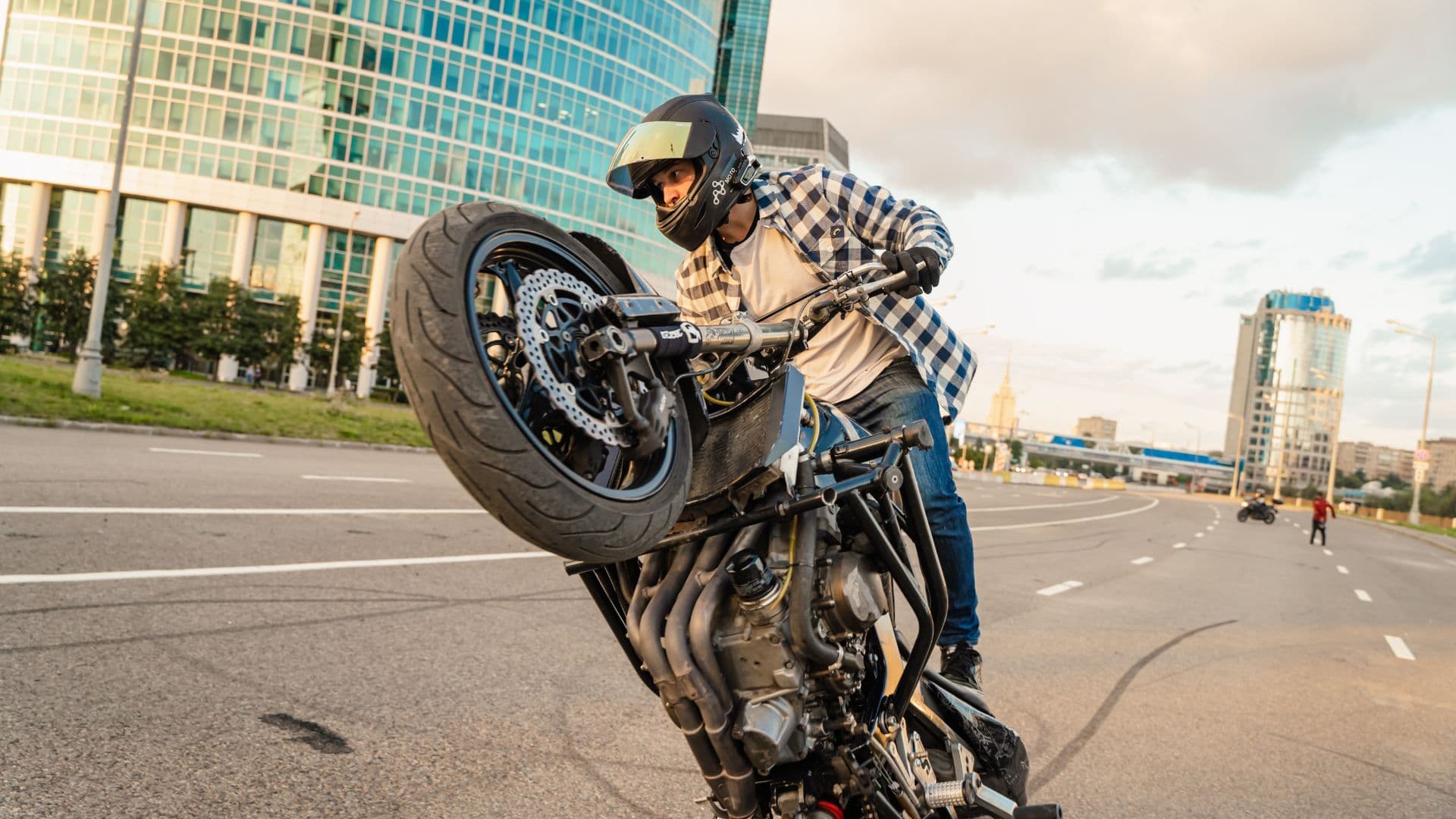
Are Wheelies Bad for Your Motorcycle? (What Actually Breaks)
Do wheelies damage your motorcycle? The real answer — what wears out, what breaks, what is fine, and how to minimize mechanical damage while learning to stunt.
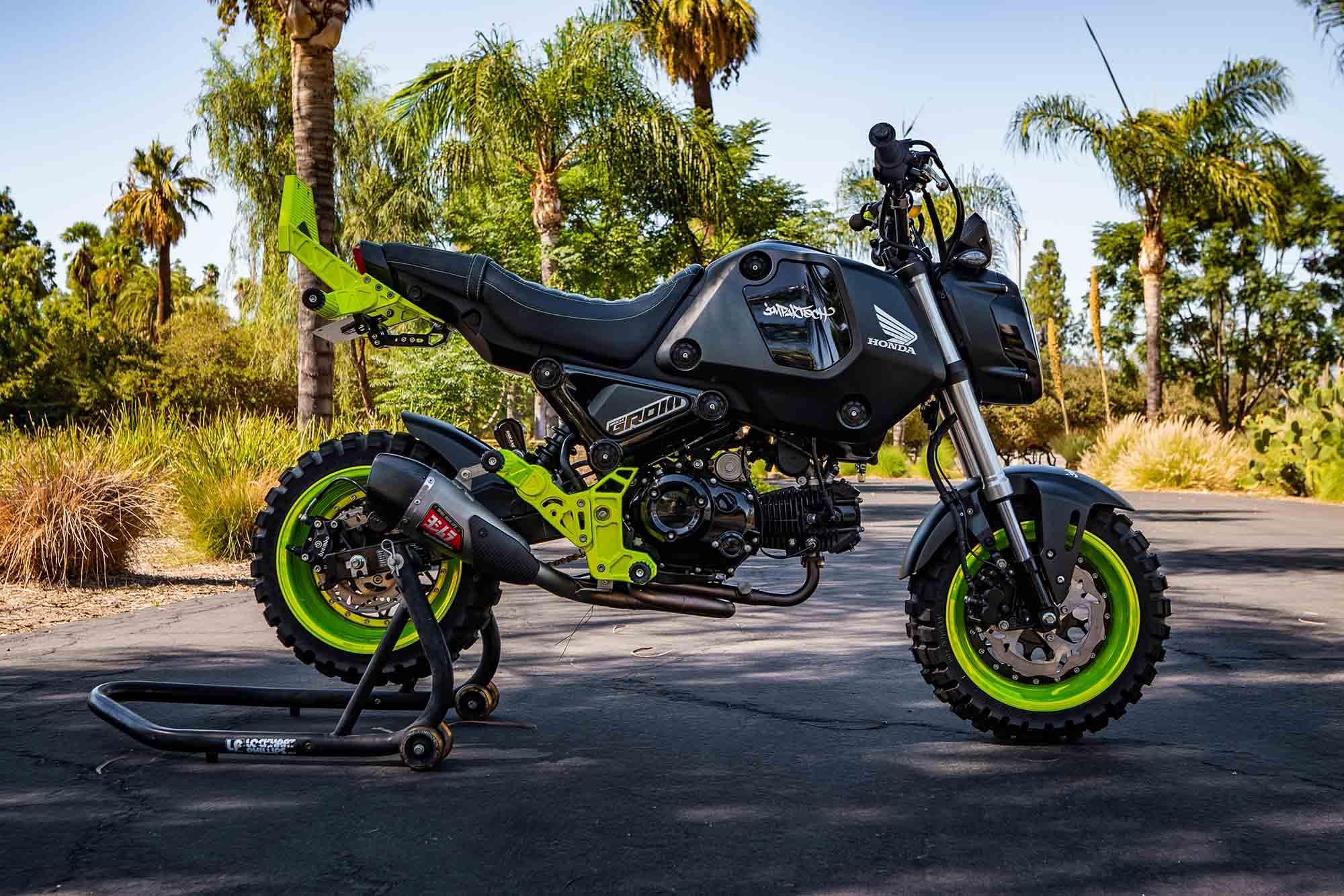
Honda Grom Stunt Build Guide: Complete Parts List and Budget Breakdown (2026)
How to build a Honda Grom for stunting from the ground up. Every part you need organized by priority, three budget tiers, which generation to buy, and what to look for used.
How to Burnout on a Motorcycle (Step-by-Step Guide)
Learn how to do a motorcycle burnout safely — tire selection, technique for standing and rolling burnouts, common mistakes, and how to protect your bike from heat and debris damage.