Insta360 for Motorcycles 2026: X4 vs X5 vs Ace
By 6FOOT4HONDA · 22 min read · Feb 25, 2026 · Updated Mar 13, 2026
This post may contain affiliate links. We only recommend gear we'd use ourselves. If you click a link and make a purchase, we may earn a small commission at no extra cost to you.
In This Article
The best Insta360 camera for motorcycles is the X5 ($549) — it has 8K 360 video, replaceable lenses for road debris damage, built-in wind noise suppression, and the invisible selfie stick effect that makes your footage look like a drone is following you. For motovlogging, the Ace Pro 2 ($399) is the top pick thanks to Leica optics and the best wind noise handling of any action camera. For lightweight 360 on a budget, the X4 Air ($399) hits the sweet spot at just 165 grams.
Insta360 has pulled ahead of GoPro for motorcycle use specifically because of three things riders care about: wind noise suppression, 360 reframing (shoot first, aim later), and replaceable lenses. With six cameras currently available, figuring out which one fits your riding style is the hard part.
This guide breaks down every Insta360 camera through the lens of motorcycle use. No generic tech specs — just what matters when you're riding.
The Insta360 X5 ($549) is the best motorcycle camera for most riders — 8K 360 video, replaceable lenses, and wind noise suppression that actually works at highway speed. For traditional motovlogging, the Ace Pro 2 ($399) with Leica optics is the top non-360 pick.
Why Is Insta360 Better Than GoPro for Motorcycles?
Before we dive into the individual cameras, here's why Insta360 has pulled ahead for motorcycle riders specifically:
- Wind noise suppression — This is the single biggest differentiator. Insta360's microphone placement, steel mesh wind guards, and AI audio processing handle highway-speed wind dramatically better than GoPro or DJI. Your engine actually sounds like an engine, not a hurricane.
- 360 reframing — The "shoot first, point later" workflow is a game-changer when you're riding solo and can't aim a camera. Capture everything in 360, then choose your angle in the app after the ride.
- Replaceable lenses — On the X5 and X4 Air, you can swap a damaged lens for ~$35 instead of mailing in the entire camera. When road debris is constantly hitting your lens, this matters.
- Invisible selfie stick — Mount it on your tail, handlebars, or crash bars with the selfie stick, and it vanishes from the footage. The result looks like a drone is following you. This is the signature Insta360 motorcycle shot.
GoPro still wins on accessory ecosystem and simplicity. If you just want to mount a camera on your full-face helmet chin bar, press record, and not think about it — the GoPro Hero 13 is still excellent. Insta360 wins when you want creative flexibility, better audio, and that cinematic 360 look.
The Full Lineup — Ranked for Riders
Best Overall: Insta360 X5
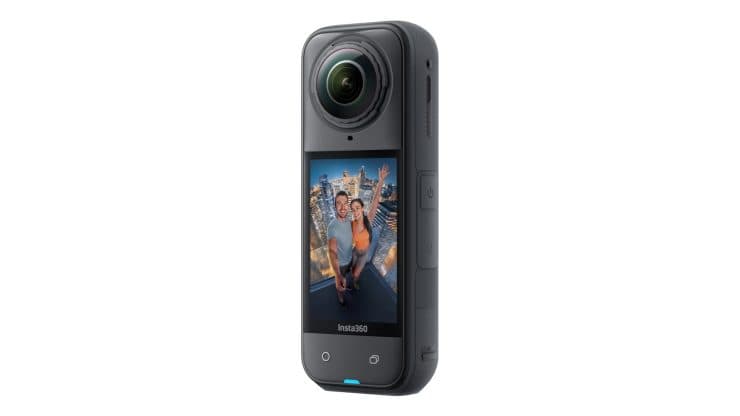
Insta360 X5
The best motorcycle camera, period. Dual 1/1.28-inch sensors, replaceable lenses, 8K 360 video, and wind noise suppression that actually works at highway speed. Shoot everything, reframe later.
The X5 is Insta360's flagship, and it's specifically built for the kind of abuse motorcycle riders dish out. The dual 1/1.28-inch sensors are 144% larger than the X4's, which means dramatically better footage in low light — dawn rides, dusk runs, and night riding all look usable instead of murky.
Why it's the best for motorcycles:
- Replaceable lenses — Rocks, bugs, and debris will scratch your lens. On the X5, you swap the lens yourself in minutes for about $35. On any other 360 camera, you're shipping it in for expensive repairs.
- Built-in wind guard — A steel mesh wind guard combined with AI processing captures clean audio at 70+ mph. You can actually hear your exhaust note.
- Gesture control — Raise your palm to start/stop recording with gloves on. Also pairs with Sena and Cardo intercoms for voice commands.
- 8K 360 video — The resolution is high enough that when you reframe to a flat 16:9 shot, it still looks sharp. Lower-res 360 cameras lose quality when you crop.
- PureVideo AI — Night riding footage that's actually usable. The triple AI chip system processes low-light footage without the noise and muddiness you get from smaller sensors.
- 49ft waterproof — No rain cover needed. Ride through storms.
The trade-offs: At 200g, it's the heaviest option for helmet mounting. On a 4-hour ride, you'll feel it on your neck. The 8K files are also massive — you'll want a decent computer for editing. Battery lasts about 2-3 hours at 5.7K.
Price: $549.99 | Motorcycle Bundle: $629.99 (includes selfie stick, lens cap, heavy duty clamp)
Best for Motovlogging: Insta360 Ace Pro 2
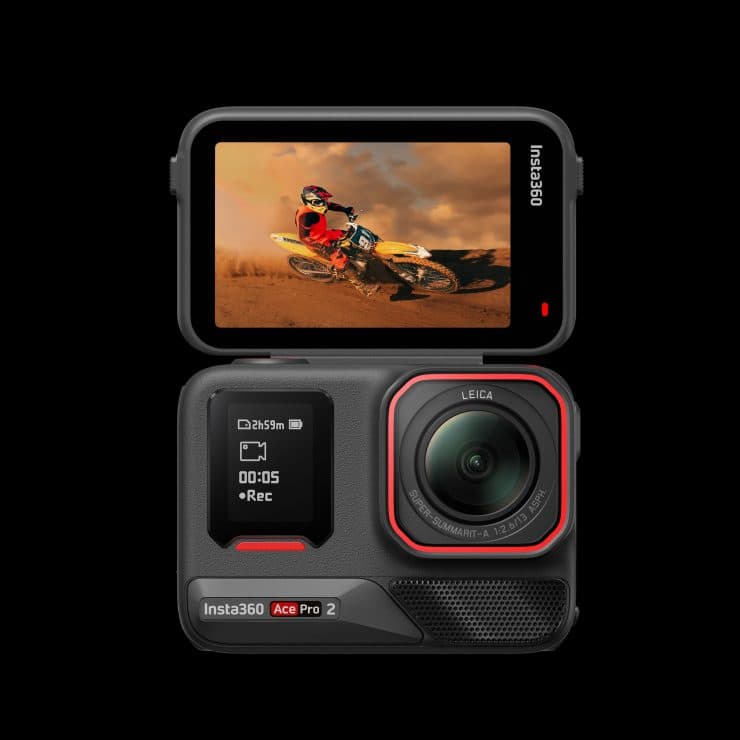
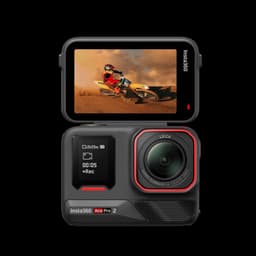
Insta360 Ace Pro 2
The best motorcycle camera for talking-to-camera content. Leica optics, 8K recording, and wind noise handling that blows GoPro away. The flip screen makes framing yourself on a chin mount dead simple.
If you're not interested in 360 video and want a traditional action camera, the Ace Pro 2 is the one. This isn't a 360 cam — it's a flat, wide-angle action camera with a Leica SUMMARIT lens, a 1/1.3-inch sensor, and the best wind noise handling of any action camera tested on a motorcycle.
Why motovloggers love it:
- Wind noise suppression — In direct comparisons, the Ace Pro 2 beat both the GoPro Hero 13 and DJI Osmo Action 5 Pro for wind noise handling at speeds up to 70 mph. The snap-on wind guard and AI audio processing make wind noise "all but disappear" while keeping your engine sound clear.
- Bluetooth mic pairing — Connects directly to Cardo Packtalk and Sena intercoms. The app has a slider to balance voice vs. engine sound vs. ambient — a feature no one else offers.
- Leica color science — Your footage looks cinematic out of the box. Rich colors, natural skin tones, and a filmic quality that GoPro's processing doesn't match.
- Flip screen — The 2.5-inch rear screen flips up so you can see yourself while chin-mounted. Perfect for framing.
- 157-degree FOV — Ultra-wide angle that captures peripheral road view and creates a sense of speed even at legal speeds.
- Dash cam mode — Loop recording for commuters who want a safety camera too.
The trade-offs: Battery life is the weak point — about 1 hour 40 minutes at 4K. That's significantly shorter than the DJI Osmo Action 5 Pro's ~3 hours. You'll want a spare battery for longer rides. It can also overheat with all settings maxed.
Price: $399.99
Best Lightweight 360: Insta360 X4 Air
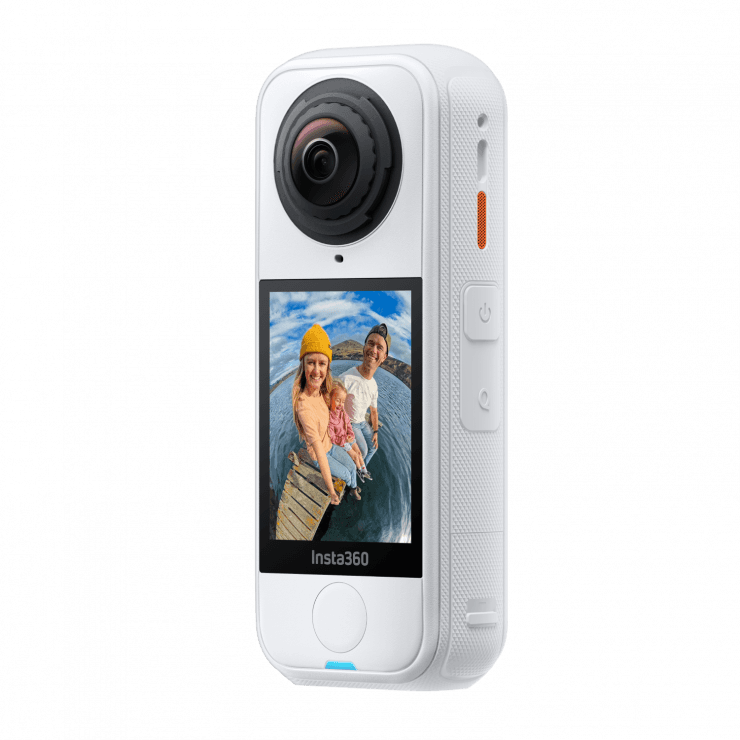
Insta360 X4 Air
All of the X5's 360 magic at 165g — the lightest 8K 360 camera ever made. Replaceable lenses, 49ft waterproof, and a natural shake mode built for capturing the feel of riding.
The X4 Air is the one I'd recommend to most riders who want 360 video but don't want to deal with the X5's weight. At 165g, it's noticeably lighter on a helmet mount, and it still shoots 8K with dual 1/1.8-inch sensors that are 134% bigger than the X4's.
What makes it special for riders:
- 165g — Lightest 8K 360 camera. You'll forget it's on your helmet.
- Natural shake mode — A stabilization setting that preserves some camera motion to convey speed and terrain. Most stabilization makes riding footage look too smooth and loses the feeling of being on a motorcycle. This mode keeps the ride alive.
- Replaceable lenses — Same as the X5, with 2x drop resistance coating.
- 49ft waterproof — Matches the X5, beats the X4.
- 6K50fps — A new mode for smoother motion than the standard 8K30fps.
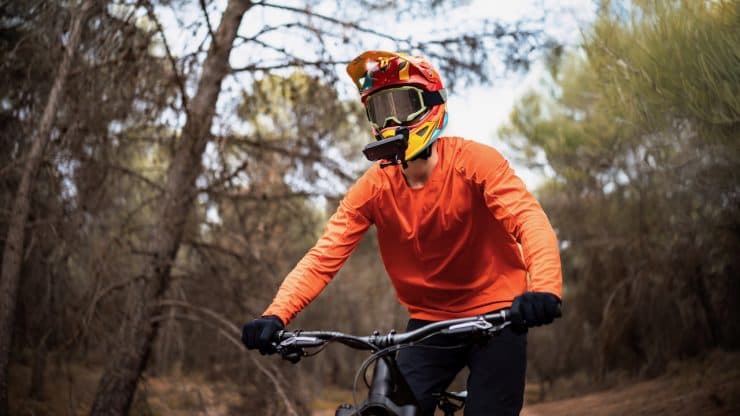
The trade-offs: Battery life is the main sacrifice — 88 minutes at 8K. That's half the X5's runtime. The sensors are also smaller than the X5's, so low-light performance isn't quite as good. Fine for daytime and golden hour, but the X5 wins at night.
Price: $399.99 | Motorcycle Bundle: $519.99
Best Secondary Camera: Insta360 GO Ultra
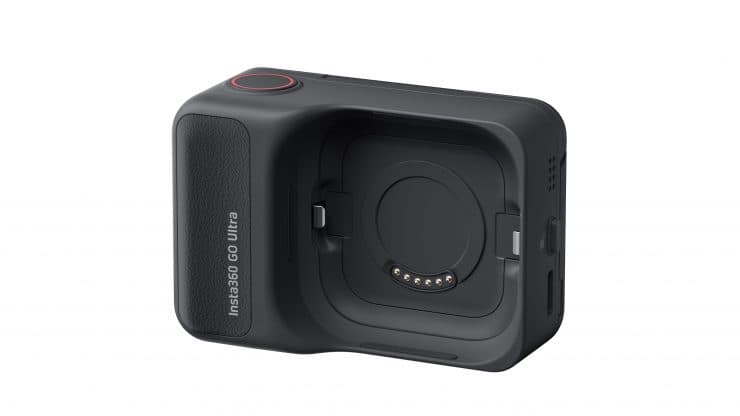
Insta360 GO Ultra
A 53-gram camera with a 1/1.28-inch sensor — the same size as the X5. Magnetic mounting means you clip it to your helmet, jacket, or gear and forget about it. Perfect as a second angle.
The GO Ultra isn't your main camera — it's the camera that captures the angle your main camera can't. At 53 grams, it's a magnetic pebble that clips to your helmet vent, jacket collar, or backpack strap. The image quality is surprisingly serious too — it has a 1/1.28-inch sensor (same size as the X5) shooting 4K60fps.
Why riders use it:
- Magnetic mounting — The Easy Clip and Magnetic Pendant let you attach it anywhere in seconds. Clip it to your helmet vent for a side-angle POV, stick it on your tank, or hang it from your chest.
- 53g — You genuinely forget it's there.
- Set and forget — QuickCapture lets you start recording hands-free.
- Safety cord — A quick-release tether prevents losing it at speed.
- 200 minutes with Action Pod — The pod extends battery from 70 to 200 minutes and adds a screen for framing.

The trade-offs: Only 4K (not 8K), so it's not a replacement for an X5 or Ace Pro 2 as your primary camera. The Action Pod is only IPX4 splash-proof — fine in light rain, risky in a downpour. The camera itself is IPX8 to 33ft though.
Price: $449.99
The killer setup for motorcycle content: an X5 on a tail-mount selfie stick for the cinematic third-person shots, and a GO Ultra clipped to your helmet for POV. Two angles, no camera operation while riding.
Budget 360 Option: Insta360 X4
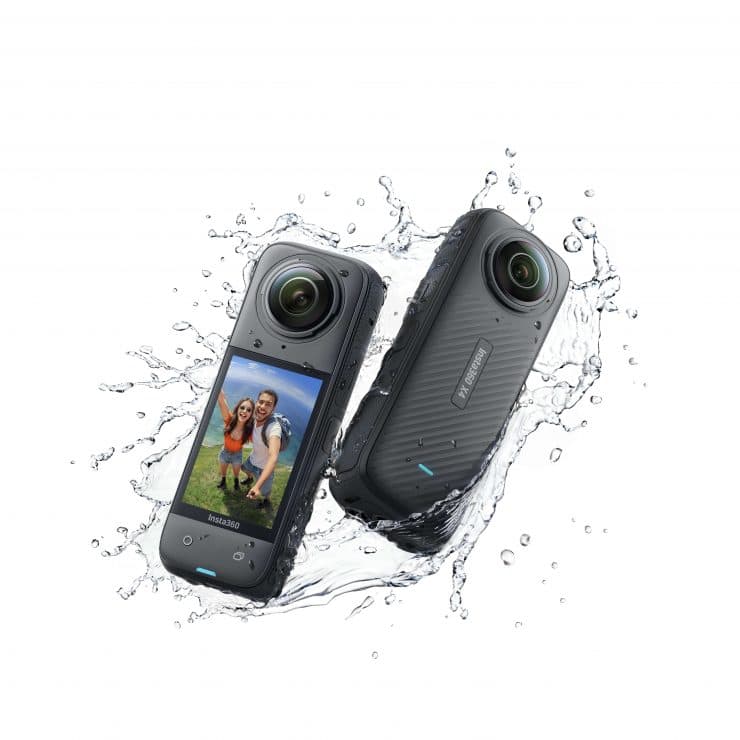
Insta360 X4
Still a solid 8K 360 camera at a lower price. If you don't need replaceable lenses or the X5's low-light performance, the X4 delivers 90% of the experience for less.
The X4 is the previous-gen 360 camera and still a capable choice. It shoots 8K30fps, has FlowState stabilization and 360 Horizon Lock, and works with all of Insta360's motorcycle mounts. If you're on a budget and the X5's $550 price tag feels steep, the X4 gets you into 360 motorcycle content for less.
Where it still holds up: 8K resolution, proven stabilization, 2.5-inch Gorilla Glass touchscreen, works down to -4°F for cold-weather riders, and 135 minutes of battery life.
Where the X5 beats it: The X4's lenses aren't replaceable — scratch one, and you're mailing the camera in for repair. Low-light performance is noticeably worse with the smaller 1/2-inch sensors. And waterproofing is 33ft vs. the X5's 49ft.
Price: $499.99
Ultra-Budget Tiny Camera: Insta360 GO 3S
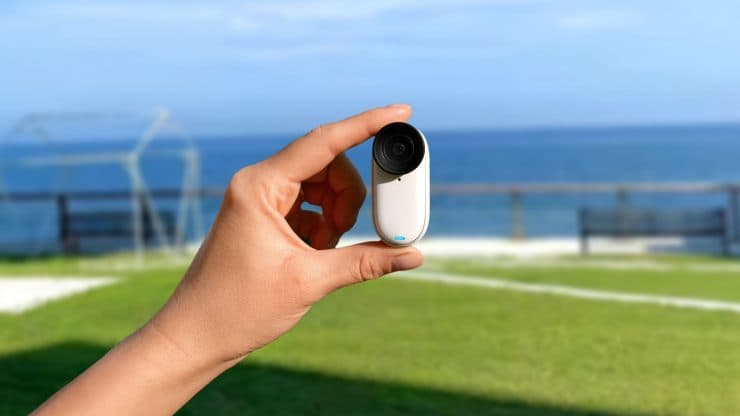
Insta360 GO 3S
At 39 grams, this thumb-sized camera can mount inside your helmet behind the visor for true first-person POV. Nothing else can do this. 4K30fps, Apple Find My, and IPX8 waterproof.
The GO 3S has one trick no other camera can pull off: it's small enough to mount inside your helmet, behind your visor, for true eye-level POV footage. You see exactly what the rider sees. The triple-lock system (shark-fin insert, Velcro, safety cord) keeps it secure, and shooting with the visor down naturally cuts wind noise.
Best for: Riders who want a discreet, set-and-forget POV camera. The 39g weight is genuinely invisible on a helmet.
Limitations: 4K30fps only (no 4K60), 32 minutes standalone battery (140 with the Action Pod), and a 1/2.3-inch sensor that struggles in low light. This is a secondary camera or a starter camera, not a primary.
Price: $399.99
Quick Comparison
| Camera | Price | Type | Resolution | Weight | Waterproof | Battery | Best For |
|---|---|---|---|---|---|---|---|
| X5 | $549 | 360 | 8K30 | 200g | 49ft | ~3 hrs | Premium 360, night riding |
| Ace Pro 2 | $399 | Action | 8K30 | 177g | 39ft | ~1.5 hrs | Motovlogging, audio quality |
| X4 Air | $399 | 360 | 8K30 | 165g | 49ft | ~1.5 hrs | Lightweight 360 |
| GO Ultra | $449 | Compact | 4K60 | 53g | 33ft | ~3.3 hrs* | Second angle, magnetic POV |
| X4 | $499 | 360 | 8K30 | 203g | 33ft | ~2.25 hrs | Budget 360 |
| GO 3S | $399 | Compact | 4K30 | 39g | 33ft | ~2.3 hrs* | In-helmet POV, ultra-discreet |
*With Action Pod
Best Camera by Riding Style
Canyon carving / spirited riding — Insta360 X5 on a tail mount. The 360 reframing lets you choose between forward POV, rear chase-cam, or sweeping cinematic pans — all from one recording. The invisible selfie stick creates those "drone following me" shots.
Commuting / daily riding — Ace Pro 2 on a chin mount with dash cam mode enabled. Simple, reliable, and doubles as a safety camera with loop recording.
Motovlogging / talking to camera — Ace Pro 2, no question. The wind noise handling, Bluetooth intercom pairing, and flip screen for self-framing make it purpose-built for this.
Track days — X5 with replaceable lenses. Track debris is brutal on camera lenses, and the X5 lets you swap them on the spot. 360 capture means you'll never miss an apex.
Touring / long rides — X4 Air for the lightweight comfort on multi-hour rides, paired with a GO Ultra as a set-and-forget secondary angle.
BikeTok / short-form content — X5 or X4 Air. The 360 reframing workflow is perfect for creating multiple clips from a single ride. One recording becomes five different TikToks. If you're just getting started, our guide on how to start creating motorcycle content covers everything from camera setup to growing an audience.
How Do You Mount an Insta360 on a Motorcycle?
| Position | Best Camera | What You Get |
|---|---|---|
| Chin mount | Ace Pro 2 / X4 Air | Immersive POV, the classic BikeTok angle |
| Helmet top | X5 / X4 | Panoramic 360 scenery (heavy on long rides) |
| Tail mount + selfie stick | X5 / X4 Air | Third-person "follow cam" — the invisible stick vanishes |
| Handlebar | X5 / X4 | Dashcam angle, scenic footage |
| Inside helmet | GO 3S | True first-person eye-level POV |
| Jacket / chest clip | GO Ultra | Secondary angle showing hands and controls |
Always use a safety tether on any helmet or body-mounted camera. A camera detaching at 60 mph becomes a projectile. Insta360's Heavy Duty Clamp and safety cords are built for this — don't skip them.
Accessories You Actually Need
Insta360 sells a dedicated motorcycle accessory ecosystem. Here's what's worth buying:
- Helmet Chin Mount 2.0 (~$20) — Fits full-face, modular, off-road, and dual-sport helmets. Includes mic mount support.
- Heavy Duty Clamp (~$30) — For handlebars, crash bars, or frame mounts. Vibration-dampened. If you're also mounting your phone, a Quad Lock motorcycle mount pairs well alongside a camera clamp.
- Action Invisible Selfie Stick (~$20) — The stick disappears from 360 footage. Essential for the "drone follow" look.
- Premium Lens Guards (~$15) — Snap-on/off lens protectors for the X5 and X4 Air. Cheaper to scratch a guard than a lens.
- Motorcycle U-Bolt Mount — Bolts to handlebars or frame for a solid, vibration-resistant mount point.
The motorcycle bundles include several of these accessories at a discount. The X5 Motorcycle Bundle ($629.99) and X4 Air Motorcycle Bundle ($519.99) are better value than buying separately.
Which Insta360 Camera Should You Buy for Motorcycle Riding?
If money isn't the issue: Get the X5. It's the most capable motorcycle camera available, and the replaceable lenses alone justify the premium over every competitor.
If you want the best value: The X4 Air at $399 gives you 8K 360, replaceable lenses, and 165g weight. It's the sweet spot for most riders.
If you're a motovlogger: The Ace Pro 2 is non-negotiable. Nothing else handles wind noise as well, and the Bluetooth intercom integration is a feature riders actually use every ride.
If you want two cameras: X5 (or X4 Air) on a tail mount + GO Ultra on your helmet. Two angles, zero camera operation while riding. This is the setup that makes your content look professional.
If you're just starting out: The X4 Air or the GO 3S. The X4 Air gets you into 360 content at a reasonable price. The GO 3S is the cheapest entry point and does one thing beautifully — in-helmet POV.
Honorable Mentions — The Rest of the Insta360 Lineup
Insta360 makes a lot more than the six cameras above. Here's every other product in their lineup, whether it's worth considering for motorcycle use, and who it's actually for.
Previous-Generation Cameras
Insta360 X3 — The predecessor to the X4. Shoots 5.7K 360 video with a 1/2-inch sensor, 72MP photos, and the same invisible selfie stick trick. Still a perfectly capable 360 motorcycle camera, and you can often find it discounted now that the X4 and X5 exist. If you're on a tight budget and want 360 reframing, the X3 at a sale price is a solid entry point. Just know the lenses aren't replaceable, and low-light performance is a step behind the newer models.
Insta360 Ace Pro (v1) — The original Ace Pro with the same Leica lens and 1/1.3-inch sensor as the Ace Pro 2, but without the improved wind noise suppression, 8K recording, and audio mixing features. Still a great action camera for motorcycle chin mounts — the Leica color science is identical. If you find it at a discount over the Ace Pro 2, it's worth considering for riders who don't need the absolute best wind noise handling.
Insta360 ONE RS — The modular action camera. Swap between a 4K wide-angle lens, a 360 lens, and a 1-inch wide-angle lens on the same camera body. Clever concept, but the modular joints create a potential failure point on a vibrating motorcycle. The 360 module shoots 5.7K which is acceptable but not as sharp as the X4 or X5. Best for riders who want both 360 and flat video without buying two cameras.
Insta360 ONE RS 1-Inch 360 Edition — A special edition of the ONE RS with dual 1-inch Leica sensors for 360 capture. At the time of release, this was the highest image quality 360 camera Insta360 offered. It's been surpassed by the X5's sensor and processing, but used units can be excellent value for riders who want premium 360 footage without the X5 price tag.
Insta360 ONE X2 — Two generations back from the X5. Shoots 5.7K 360, IPX8 waterproof, and has the same invisible selfie stick trick. The stabilization and image quality are noticeably behind the current lineup, but it's still functional for casual motorcycle content. Only worth buying used at a steep discount — the X3 is a much better value at its current price.
Specialty Cameras
Insta360 SMO 4K — A tiny camera designed for FPV drones, not motorcycles. 4K stabilized video in a 30g form factor. Some riders have experimented with mounting it on their bike frame for unique low-angle shots, but it lacks weather sealing and wind noise handling. Only interesting for creative experimenters.
Smartphone Gimbals
Insta360 makes three phone gimbals. While these aren't action cameras, they're worth knowing about if you use your phone to film walk-around reviews of bikes, post-ride vlogs, or parking lot content.
Insta360 Flow 2 Pro — Their flagship 3-axis phone gimbal with AI tracking, gesture control, and a built-in selfie stick. The DualTrack AI mode locks onto subjects even when they move behind objects. Great for filming yourself walking around your motorcycle, gear reviews in the garage, or B-roll of your bike at scenic overlooks. Not for on-bike use — gimbals can't handle motorcycle vibration.
Insta360 Flow Pro — The previous generation with the same 3-axis stabilization and AI tracking, just without the Flow 2 Pro's newer processing. Still excellent for off-bike content creation.
Insta360 Flow — The budget gimbal. 3-axis stabilization without the AI tracking features. Fine for basic phone video stabilization during walk-arounds and vlogs.
Webcams
Insta360 Link 2 Pro / Link 2 / Link — AI-powered 4K webcams with tracking and gesture control. Zero motorcycle relevance, but if you're a motovlogger who also streams or does video calls, the Link 2 Pro's ability to track you as you move around a workshop or garage is genuinely useful.
iPhone Accessories
Insta360 Wave — An iPhone case with a magnetic mount system and snap-on lenses (anamorphic, macro, wide). More of a casual photography accessory. Not relevant for motorcycle riding, but the magnetic mount system could theoretically be used to quickly dock your phone as a dashcam.
Professional & Enterprise
Insta360 Pro 2 — Professional 8K VR camera for filmmakers. Six lenses, real-time stitching, $5,000+ price. If you're creating professional motorcycle VR content for a production company, this is what you'd use. For everyone else, the X5 does more than enough.
Insta360 Titan — The absolute top-end: 11K resolution, eight Micro Four Thirds sensors, designed for cinematic VR production. Costs as much as a motorcycle. Not for individual creators.
Insta360 Virtual Tour Kit — A camera and software bundle designed for real estate virtual tours. No motorcycle relevance unless you're photographing a motorcycle showroom.
Insta360 Construction Kit — Industrial safety monitoring camera for construction sites. Not consumer-facing.
Insta360 Insight — Enterprise workplace safety camera. Not consumer-facing.
Subscription
Insta360+ — Insta360's subscription service. Includes cloud storage, premium editing features, extended warranty, and discounts on accessories. Worth considering if you're an active creator uploading frequently — the cloud backup alone gives peace of mind when you're carrying footage from a multi-day riding trip.
For most motorcycle riders, the six cameras reviewed above are the only ones worth buying new. If you're on a tight budget, look for the X3 or Ace Pro v1 on sale — they're still excellent cameras that handle motorcycle content well.
The Bottom Line
Insta360 has built a camera ecosystem that genuinely understands motorcycle riders. The wind noise suppression, replaceable lenses, 360 reframing, and invisible selfie stick aren't gimmicks — they solve real problems that every rider with a camera deals with. Whether you're building a BikeTok following or just want to capture your weekend rides, there's an Insta360 camera that fits. Pair it with the best motorcycle apps to plan routes, track rides, and share your footage.
The X5 is the best motorcycle camera you can buy. The X4 Air is the best value. The Ace Pro 2 is the best for motovlogging. And the GO Ultra is the best "set it and forget it" secondary angle. Pick the one that matches how you ride, mount it up, and get out there.
Frequently Asked Questions
What is the best camera for motorcycle riding in 2026?
The Insta360 X5 is the best overall motorcycle camera in 2026. It offers 8K 360 video, replaceable lenses, built-in wind noise suppression, and the invisible selfie stick effect. For motovlogging specifically, the Insta360 Ace Pro 2 is the top choice.
Is Insta360 or GoPro better for motorcycles?
Insta360 is better for most motorcycle riders due to superior wind noise suppression, 360 reframing that lets you choose your angle after the ride, replaceable lenses for road debris damage, and the invisible selfie stick. GoPro still wins on simplicity and accessory ecosystem.
Where is the best place to mount a camera on a motorcycle?
The most popular mount positions are a chin mount for immersive POV footage, a tail mount with an invisible selfie stick for cinematic third-person shots, and handlebars for a dashcam angle. Chin mounts work best with the Ace Pro 2 or X4 Air.
How do you reduce wind noise on a motorcycle camera?
Use a camera with built-in wind noise suppression like the Insta360 Ace Pro 2 or X5 which have steel mesh wind guards and AI audio processing. Mounting inside the helmet fairing or behind a windscreen also helps. External foam wind covers reduce noise on older cameras.
Can you use a motorcycle camera as a dashcam?
Yes, the Insta360 Ace Pro 2 has a dedicated dash cam mode with loop recording that continuously records and overwrites old footage. This provides evidence in case of an accident. Several other action cameras also support loop recording for this purpose.
How long does the Insta360 X5 battery last on a motorcycle?
The Insta360 X5 lasts about 2-3 hours at 5.7K resolution and roughly 80 minutes at full 8K. For longer rides, the X4 Air lasts about 88 minutes at 8K. Carry a spare battery or use a USB power bank for touring days.
What is the invisible selfie stick trick on a motorcycle?
When you mount an Insta360 360 camera (X5, X4 Air, or X4) on a selfie stick, the stick disappears from the footage because it falls in the blind spot between the two lenses. The result looks like a drone is following your motorcycle — no editing required.
Which Insta360 is lightest for helmet mounting?
The Insta360 GO 3S at 39 grams is the lightest, small enough to mount inside your helmet behind the visor. For a full-featured 360 camera, the X4 Air at 165 grams is the lightest 8K option and noticeably more comfortable than the 200g X5 on long rides.
Written by
6FOOT4HONDAMotorcycle creator with 1.2M+ subscribers on YouTube and 2M+ across all platforms. Riding and filming since 2016, with 1,000+ videos covering beginner riding tips, gear reviews, stunts, and road trips. Every product recommended on this site has been personally tested on real rides — from highway touring to track days to stunt sessions. Based in the US, riding year-round.
Related Articles
Best Motorcycle Riding Shoes 2026 (Not Boots)
The TCX Street 3 WP is the best motorcycle riding shoe at $95-$110 on closeout. D3O ankle armor, waterproof, looks like a normal sneaker.
Full Face vs Modular vs Half Helmet 2026
I've worn all 4 helmet types. Full face wins for beginners — here's noise data, safety stats, and top picks.
Best Motorcycle Pants for Beginners 2026 (7 Picks)
The best motorcycle pants for beginners are kevlar riding jeans — they protect like gear and look like regular clothes. 7 picks from $80 to $600.