How to Get Your Motorcycle License: The Complete Step-by-Step Guide (2026)
By 6FOOT4HONDA · 14 min read · Mar 3, 2026 · Updated Mar 4, 2026
This post may contain affiliate links. We only recommend gear we'd use ourselves. If you click a link and make a purchase, we may earn a small commission at no extra cost to you.
In This Article
You want to ride a motorcycle legally. The process is straightforward, but nobody explains it clearly because it varies by state and the DMV website reads like it was written by a robot having a bad day.
Here's the simplified version: in every US state, you need a motorcycle endorsement on your driver's license (or a standalone motorcycle license). Getting it involves some combination of a written test, a riding test, and/or completing an approved safety course.
This guide covers every path, what the MSF course actually involves, and the fastest way to get your endorsement regardless of which state you're in. If you're brand new to motorcycles entirely, start with our complete beginner's guide to motorcycles for the big picture before diving into licensing.
In most US states, you need to pass a written permit test, complete the MSF Basic RiderCourse (which waives the DMV skills test in 46 states), and pay $15-30 for the endorsement. The entire process takes 2-4 weeks.
The Two Paths to Your License
Path 1: MSF Course (Recommended)
The Motorcycle Safety Foundation (MSF) Basic RiderCourse is a 2-3 day program that includes classroom instruction and hands-on riding exercises. In most states, completing the MSF course waives the riding test at the DMV — you walk in with your completion card and they add the endorsement to your license.
Why this is the better path:
- They provide the motorcycle and helmet — you don't need to own a bike yet
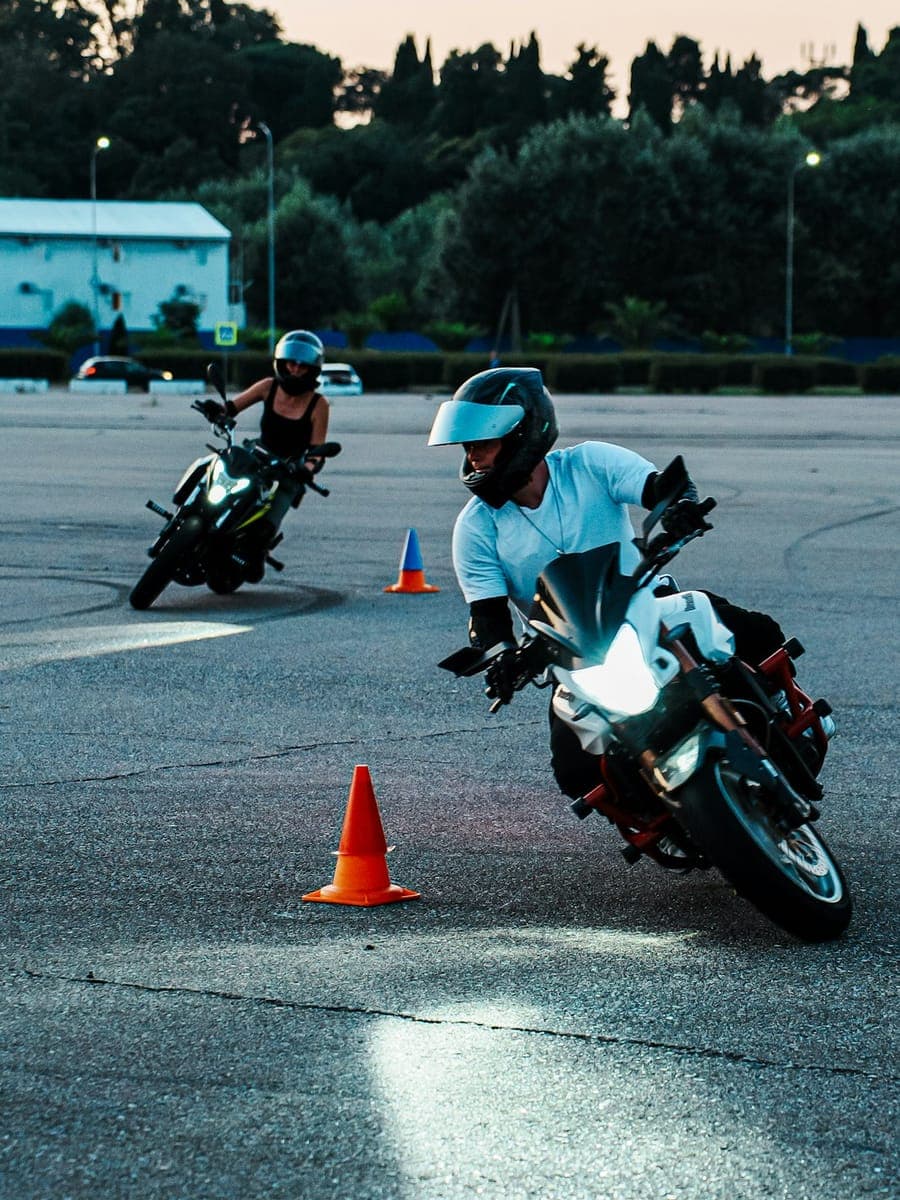
- You learn from professional instructors in a controlled parking lot environment
- The skills test at the end of the course IS your riding test — no separate DMV road test
- Insurance companies give discounts (usually 10-15%) for MSF completion — read our motorcycle insurance guide for more ways to save
- You build actual skills before riding on the street
Cost: $200-350 depending on your state. Some states subsidize the course and it's as low as $25-50.
Duration: Typically one evening classroom session (2-4 hours) plus two full days of riding exercises (Saturday and Sunday, 8 AM - 5 PM).
Book the MSF course early. In spring and summer, courses fill up weeks in advance — especially in warmer states. January and February are the easiest months to get a spot. Visit msf-usa.org or your state's motorcycle safety program website to find courses near you.
Path 2: DMV Written + Riding Test
If you skip the MSF course, you'll need to pass both a written knowledge test and a riding skills test at your local DMV or testing center.
Written test: 20-30 multiple choice questions covering traffic laws, motorcycle-specific rules, and safety knowledge. Study your state's motorcycle operator manual (available free online from your DMV website). Most people pass on the first try with a few hours of studying.
Riding test: You bring your own motorcycle (registered, insured, inspected) and demonstrate basic riding skills in a DMV parking lot or test course. The test typically includes:
- Straight-line riding at low speed
- U-turns within a marked box
- Controlled stops from various speeds
- Cornering and swerving exercises
- Quick stop (emergency braking)
Why some riders choose this path: It's faster if you already know how to ride (learned from a friend or family member) and you don't want to spend a weekend in a course. But you miss out on the structured instruction, and the DMV riding test has a higher failure rate than the MSF course completion rate.
Step-by-Step: The MSF Course Route
This is the route most new riders take. Here's exactly what happens.
Step 1: Get Your Motorcycle Permit
Before you can take the MSF course in most states, you need a motorcycle learner's permit. This involves:
- Go to your local DMV
- Pass the written knowledge test (or in some states, this is waived if you're taking the MSF course)
- Pay the permit fee ($10-30)
- Receive your motorcycle permit
What a permit allows: You can ride a motorcycle on public roads with restrictions — typically no passengers, no nighttime riding, and no highway riding. Restrictions vary by state.
What a permit does NOT allow: Unrestricted riding. You need the full endorsement for that.
Some states let you take the MSF course without a permit. Check your state's requirements before going to the DMV. If the MSF course waives both the written and riding test, you might only need to visit the DMV once — after the course — to get your endorsement directly.
Step 2: Take the MSF Basic RiderCourse
Classroom session (Day 1 evening or Day 1 morning):
- Basic motorcycle controls and their functions
- Protective gear requirements
- Traffic strategy and hazard awareness
- Alcohol and drug awareness
- Mental preparation for riding
Riding exercises (Day 2 and Day 3, or over a weekend):
You'll ride a provided motorcycle (usually a small 250cc bike — Rebel 250, TW200, or similar) through progressively challenging exercises:
- Friction zone and slow-speed control — Learning the clutch engagement point. Walking pace riding. This is where most new riders struggle initially.
- Straight-line riding — Basic throttle, braking, shifting through gears.
- Turning — Wide turns, tight turns, figure-8s. Slow-speed maneuvering.
- Stopping — Normal stops and quick stops. Using both brakes.
- Swerving — Emergency obstacle avoidance.
- Cornering — Proper body position and line selection through curves.
The skills evaluation: At the end of the course, you'll ride through a scored evaluation that tests everything you learned. It's not pass/fail in the scary DMV sense — the instructors have been coaching you all weekend and most students pass. The national pass rate is around 90%.
If you don't pass: Most courses let you retake the riding portion once at no additional cost. You're not starting over — just repeating the evaluation.
Step 3: Take Your Completion Card to the DMV
After passing the MSF course, you receive a completion card (MSF DL-389 or your state's equivalent). Take this card to the DMV along with:
- Your current driver's license (or ID)
- Your motorcycle permit (if you got one)
- The MSF completion card
- Payment for the endorsement fee ($15-30)
In most states, the MSF card waives both the written and riding tests. The DMV adds the motorcycle endorsement (usually an "M" designation) to your existing driver's license. You walk out legally endorsed to ride.
Step-by-Step: The DMV Direct Route
Step 1: Study the Motorcycle Manual
Download your state's motorcycle operator manual from your DMV website. It's usually 50-80 pages covering:
- Motorcycle controls and basic operation
- State-specific traffic laws for motorcycles
- Protective gear requirements
- Riding in traffic, hazard awareness
- Alcohol/impairment information
Study for 3-5 hours minimum. The written test isn't hard, but it does cover specific details (like BAC limits, following distances, and lane positioning) that you'll miss if you just wing it.
Step 2: Pass the Written Test
Visit your DMV, pay the permit/test fee, and take the written exam. It's multiple choice, typically 20-30 questions, and you need 80% to pass. You can retake it if you fail, usually after a waiting period (24 hours to a week depending on the state).
Step 3: Get Your Permit
With the written test passed, you'll receive your motorcycle permit. Ride with permit restrictions for the required period (varies by state — some require 30-90 days before you can take the riding test).
Step 4: Practice
Use the permit period to actually practice riding. Start in empty parking lots, then progress to neighborhood streets, then busier roads. Build skills progressively.
Step 5: Schedule and Pass the Riding Test
Book your riding test at the DMV. You'll need to bring:
- A registered, insured motorcycle in working condition
- Your permit and identification
- Appropriate gear (helmet required in most states, some require gloves and boots)
- Someone to ride the bike to the DMV if you don't have a full license yet
The test takes about 15-20 minutes and covers the maneuvers listed above. Pass rates vary but are generally lower than MSF course completion rates — about 70-80%.
Step 6: Get Your Endorsement
Pass the riding test, pay the fee, receive your endorsement. Done.
State-Specific Differences
While the general process is similar everywhere, specific requirements vary:
| Requirement | Varies By State |
|---|---|
| Minimum age for permit | 14-16 years old |
| Minimum age for full license | 16-18 years old |
| Written test required | Yes in most states |
| MSF course waives riding test | Yes in most states |
| MSF course waives written test | Some states |
| Helmet law for licensed riders | Varies widely |
| Permit restrictions | Duration, time of day, passengers |
| Endorsement fees | $15-30 |
Check your specific state's requirements at your DMV website or at msf-usa.org, which lists state-by-state requirements and links to local course providers.
Riding without a license or endorsement is a misdemeanor in most states. Fines range from $100-$1,000+, and your bike can be impounded. More importantly, if you crash without proper licensing, your insurance may deny the claim entirely. Get legal before you ride on public roads.
What the MSF Course Won't Teach You
The MSF course is excellent for fundamentals, but it has limitations:
- Top speed in the course is about 20 mph. You won't practice highway riding, high-speed braking, or freeway merging.
- No traffic. The course is in a parking lot. Dealing with cars, trucks, and intersections is learned on the street.
- No night riding. Courses run during the day.
- No rain riding. Unless it happens to rain during your course (and some courses cancel for rain).
The MSF gets you legal and gives you foundational skills. The real learning starts on the street. Plan to ride conservatively for your first 1,000 miles — that's where you build the judgment, hazard awareness, and muscle memory that keep you alive. Our guide on how to ride a motorcycle picks up where the MSF course leaves off.
Gear You Need Before Your First Ride
The MSF course provides a bike and helmet, but once you pass and start riding on the street, you need your own gear:
Minimum (absolute bare minimum):
- DOT-certified helmet
- Closed-toe shoes (boots preferred)
- Long pants
- Gloves
- Eye protection (if using an open-face helmet)
Recommended (what you should actually wear):
- Full-face helmet with Pinlock visor (ECE or DOT certified)
- Armored riding jacket
- Riding gloves (knuckle protection + palm sliders)
- Riding boots (above the ankle)
- Riding pants (kevlar jeans at minimum)
Check out our beginner motorcycles guide for what bike to buy, our best beginner helmets guide for helmet recommendations, and our complete riding gear guide for everything else.
Common Questions
"Can I get a motorcycle license without a car license?"
Yes, in most states. You can get a standalone motorcycle license or permit without having a standard driver's license. The requirements are the same — written test + riding test or MSF course.
"I already know how to ride. Do I still need the MSF course?"
You don't need it, but you should take it. Even experienced riders learn something in the MSF course. The emergency braking and swerving exercises alone are worth the cost. Plus, the insurance discount often pays for the course within the first year.
"How long does the whole process take?"
MSF route: 1-3 weeks (time to book the course + the weekend course + DMV visit). DMV direct route: 1 day to several months, depending on permit requirements and riding test availability.
"Can I ride a scooter or moped without a motorcycle license?"
Depends on the state and engine size. Most states require a motorcycle endorsement for any two-wheeled motor vehicle over 49-50cc. Scooters and mopeds under 49cc often only require a regular driver's license. Check your state's specific regulations.
Take the MSF course even if your state doesn't require it. The skills you learn — especially emergency braking and low-speed maneuvering — will save you from crashes in your first year. The $250-350 cost is nothing compared to the cost of a single dropped bike or an ER visit.
Frequently Asked Questions
How much does it cost to get a motorcycle license?
The total cost ranges from $50 to $400 depending on your state. The MSF course costs $200-350, the permit fee is $10-30, and the endorsement fee is $15-30. Some states subsidize the MSF course for as low as $25.
Can I get a motorcycle license without owning a motorcycle?
Yes. The MSF Basic RiderCourse provides a motorcycle and helmet for you to use during the course. You only need your own bike if you take the DMV riding test directly without the MSF course.
How long does it take to get a motorcycle license?
Through the MSF course route, most riders complete the process in 1-3 weeks including booking the course, the weekend class, and a DMV visit. The DMV direct route can take anywhere from one day to several months.
Do I need a regular drivers license to get a motorcycle license?
No, most states allow you to get a standalone motorcycle license or permit without holding a standard drivers license. The requirements are the same - a written test plus a riding test or MSF course completion.
What happens if I fail the motorcycle riding test?
If you fail the MSF course evaluation, most programs let you retake the riding portion once at no extra cost. If you fail the DMV riding test, you can usually retake it after a short waiting period of 24 hours to one week.
Written by
6FOOT4HONDAMotorcycle creator with 1.2M+ subscribers on YouTube and 2M+ across all platforms. Riding and filming since 2016, with 1,000+ videos covering beginner riding tips, gear reviews, stunts, and road trips. Every product recommended on this site has been personally tested on real rides — from highway touring to track days to stunt sessions. Based in the US, riding year-round.
Related Articles
Best Motorcycles for Women 2026
14 bikes ranked by seat height, weight, and fit. Includes the inseam-to-seat chart nobody else has and the gatekeeping myths you need to ignore.
Motorcycle CC Explained (What It Means)
CC measures engine displacement, not speed. Here's what it actually means, why a 650cc cruiser feels nothing like a 650cc sportbike, and what CC to start on.
Is a Motorcycle Worth It? (Costs, Risks, Benefits)
A motorcycle is worth it if you budget $4,000-$8,000 for year one and understand the real risks. Honest breakdown from a rider with 1M+ subscribers.