How to Pick Up a Dropped Motorcycle (Without Hurting Yourself)
By 6FOOT4HONDA · 10 min read · Mar 3, 2026 · Updated Mar 4, 2026
This post may contain affiliate links. We only recommend gear we'd use ourselves. If you click a link and make a purchase, we may earn a small commission at no extra cost to you.
In This Article
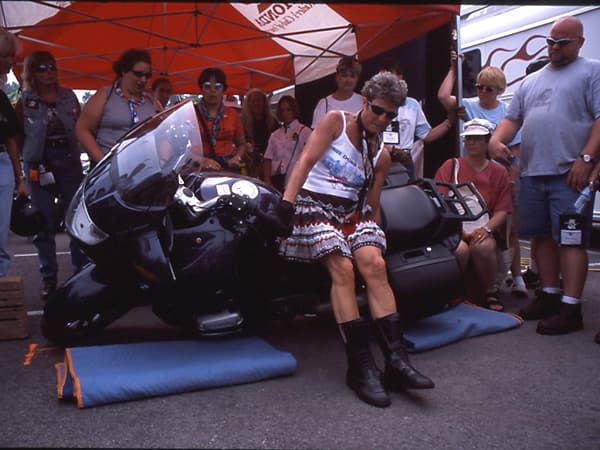
To pick up a dropped motorcycle, turn your back to the bike, squat your hips against the seat, grab the lower handlebar grip and rear grab rail, then walk backward using small steps. Your legs do the lifting, not your arms or back. This technique lets even a 120-pound rider lift a 500-pound motorcycle safely.
You're going to drop your motorcycle. Every rider does. It might happen at a gas station when you forget to put the kickstand down. It might be a slow-speed tip in a parking lot. It might be gravel under your boot at a stop sign. It will happen — and when it does, you need to know how to pick it up without throwing out your back.
A motorcycle weighs 300-600 lbs depending on the model. Lifting that with your arms is a guaranteed injury. But with the right technique — using your legs, hips, and leverage — a 120-lb rider can pick up a 500-lb touring bike solo. It's physics, not strength. NHTSA estimates there are over 80,000 motorcycle-involved incidents annually, and knowing how to recover from a simple tip-over is an essential skill.
Step 1: Turn Off the Engine
Before you touch the bike, kill the engine. If the bike fell while running, the kill switch is your friend. A running engine on a downed bike can spin the rear wheel (dangerous if it catches traction), leak fluids onto hot surfaces, and drain the battery.
Turn off the fuel (if carbureted). Carbureted bikes will leak fuel from the carbs when tilted. Turn the petcock to OFF. Fuel-injected bikes have sealed fuel systems and won't leak.
Put the bike in gear. First gear prevents the bike from rolling forward or backward when you start lifting it.
Step 2: Assess the Situation
Take a breath. The adrenaline is pumping and your instinct is to immediately try to muscle the bike upright. Don't. Take 10 seconds to assess:
- Are you injured? If you went down with the bike, check yourself first. A strained muscle will become a torn muscle if you immediately try to deadlift 450 lbs.
- Is the ground level? Lifting a bike on a slope is harder — you may need to lift it uphill. If the bike is on a steep slope, you might need help.
- Is there fluid leaking? If gas or oil is pooling, be aware of slipping on it. Handle the leak after the bike is up.
- Which side is down? The technique is the same regardless, but if the kickstand side is down, you need to deploy the kickstand before you begin lifting (or the bike will fall to the other side when you get it upright).
Deploy the kickstand first (if accessible). If the bike is down on the left side (kickstand side), reach under and flip the kickstand down before lifting. When you push the bike upright, it'll catch on the kickstand instead of going over to the other side. If the bike is down on the right side, the kickstand deploys naturally as you lift past center.
Step 3: The Lifting Technique
This technique — taught in the MSF Basic RiderCourse — works for any motorcycle, any weight, any rider size. It uses your legs and hips — the strongest muscles in your body — instead of your arms and back.
Setup
- Stand with your back to the bike. Turn around so your butt is facing the seat/tank area.
- Squat down and sit your butt against the seat or the edge of the tank. You should feel the bike's weight against your lower back and glutes.
- Grab two contact points.
- Low hand: Grab the lowest handlebar grip (or frame rail) with the hand closest to the ground. This is your control hand.
- High hand: Grab the rear grab rail, subframe, or any solid mounting point near the rear of the bike with your other hand.
- Feet placement. Your feet should be shoulder-width apart, close to the bike, with your back foot slightly behind you for balance. Point your toes slightly outward.
The Lift
- Walk backward using small steps. Don't try to lift with your arms. Instead, take small steps backward, pushing your butt and hips into the bike. Your legs do the work — it's like doing a wall sit in reverse.
- Keep your back straight. Never bend at the waist. The power comes from your legs pushing you backward into the bike, not from your back arching upward.
- Small, steady steps. Each step pushes the bike up a few more degrees. The first few inches are the hardest — the bike is nearly horizontal and the leverage is worst. After you get it past about 30 degrees, momentum helps.
- As the bike approaches vertical, slow down. The last 10 degrees go fast because the center of gravity shifts. Don't push it over to the other side — ease it onto the kickstand or until it's balanced.
Common Mistakes
- Trying to lift with your arms. Your arms just hold on — they don't lift. All lifting force comes from your legs.
- Bending at the waist. This puts all the stress on your lower back. Herniated discs happen this way. Keep your back straight, squat with your legs.
- Taking big steps. Big steps cause you to lose contact with the bike and drop it again. Small steps keep constant pressure.
- Rushing the final degrees. The bike gets light near vertical. If you push too hard, it goes right over to the other side. Ease it up.
If the bike is too heavy, ask for help. There's zero shame in asking a bystander, another rider, or calling a friend. Two people can easily lift any motorcycle. Hurting your back to prove a point isn't worth it — back injuries can end your riding career.
Step 4: What to Check Before Riding
A dropped motorcycle isn't automatically damaged, but it needs a quick inspection before you ride it. Some issues are cosmetic. Some are dangerous.
Immediate Safety Checks (Do These Now)
Handlebars: Are they straight? Sit on the bike, hold the bars, and look at the front wheel. If the wheel points slightly left or right when the bars feel straight, the forks may be twisted in the triple clamp. This is common in drops and usually fixed by loosening the triple clamp bolts, straightening the wheel, and retightening. It's not a bend — just a rotation.
Brake and clutch levers: Are they bent or snapped? A broken lever means you can't brake or shift. If the lever is bent but functional, you can ride carefully to get home. If it's snapped, you need a spare lever or a tow. This is why we recommend carrying a spare lever on road trips.
Footpegs and shift lever: Fold out the pegs and test the shift lever. If the shift lever is bent, you may not be able to shift properly. A bent shift lever can sometimes be bent back by hand or with pliers — it doesn't need to be perfect, just functional enough to get home. This is exactly why carrying a basic tool kit matters.
Mirrors: Cracked or dangling mirrors need to be either repositioned or removed before riding. A mirror flapping in the wind at speed is a distraction and a hazard.
Throttle: Roll the throttle open and closed. It should move freely and snap back to closed when released. If it sticks open, don't ride.
Lights: Check headlight, tail light, brake light, and turn signals. A broken turn signal lens is cosmetic, but a dead headlight or tail light means you're invisible at night.
Visual Inspection
Fluid leaks: Look under the bike for oil, coolant, or brake fluid. A small weep from a scratched engine cover is usually cosmetic. A steady drip is a problem. Brake fluid leaking from a damaged brake line is a NO RIDE situation.
Coolant: If the radiator took the impact, check for coolant spray on the engine or ground. A cracked radiator won't end the ride immediately, but overheating will. Watch the temperature gauge.
Exhaust: Check that the exhaust isn't cracked at the header joint or disconnected from the engine. An exhaust leak is loud and can direct heat toward parts that shouldn't be hot.
Fairings: Cracked or scraped fairings are cosmetic. Missing fairings that expose wiring or fluid lines are a concern. Secure any loose fairing pieces with zip ties to prevent them from falling off at speed.
Things That Look Bad But Are Usually Fine
| Damage | Severity |
|---|---|
| Scratched bar end / mirror | Cosmetic only |
| Scraped engine cover | Usually cosmetic (check for oil seep) |
| Scratched exhaust heat shield | Cosmetic |
| Cracked fairing / body panel | Cosmetic (zip tie if loose) |
| Bent lever | Ride carefully, replace when possible |
| Scratched tank | Painful but cosmetic |
Things That Mean Don't Ride
| Damage | Why |
|---|---|
| Brake fluid leaking | No brakes. Tow it. |
| Throttle sticks open | Uncontrollable acceleration. Fix it first. |
| Bent fork tube | Compromised steering. Tow it. |
| Cracked frame | Structural failure. Tow it. |
| Wheel damage (bent rim, broken spokes) | Tire won't seal, wheel won't track straight. Tow it. |
| Handlebar won't turn freely | Something is binding the steering. Don't ride. |
The Emotional Part
Dropping your bike feels terrible. Your heart is pounding, bystanders are staring, and you're convinced you've ruined your motorcycle. Take a breath.
Reality check:
- Every experienced rider has dropped a bike at least once. Many have done it multiple times. It's a universal experience.
- Most drops cause $50-$200 in cosmetic damage (bar ends, levers, mirrors, fairing scratches). The bike is almost certainly fine mechanically.
- The embarrassment fades in 24 hours. The scratches become "character."
- Frame sliders and crash bars exist specifically to take the hit instead of your bike's expensive parts. If you haven't installed them yet, this is your sign.
- If the drop happened because the bike was knocked over while parked, a disc lock or chain lock can help prevent tampering when you're not around.
Frame Sliders / Crash Bobbins
Bolt-on pucks that protrude from the frame and take the impact of a drop instead of your fairings, engine covers, and handlebars. They sacrifice themselves so your expensive parts survive. $30-$80 for a pair that could save $500+ in fairing damage on the first drop.
Practice Picking Up Your Bike
This sounds weird, but it works: practice the pickup technique in your driveway before you need it for real.
- Park on level ground (grass is ideal — softer landing for the bike)
- Put the bike on the kickstand
- Gently lower the bike to the ground on the opposite side of the kickstand
- Practice the back-to-the-bike technique to lift it
Doing this once or twice in a controlled setting builds the muscle memory and confidence so that when it happens for real — in a gas station, in front of an audience — you pick the bike up cleanly instead of panicking.
The drop is inevitable. The recovery is a skill. And like every skill on a motorcycle, it gets easier with practice.
Frequently Asked Questions
Can one person pick up a dropped motorcycle?
Yes, one person can pick up any motorcycle using the proper technique. Turn your back to the bike, squat against the seat, and walk backward using small steps. Your legs do the lifting, not your arms or back.
How heavy is too heavy to pick up a motorcycle alone?
With the correct back-to-the-bike technique, a 120-pound rider can lift a 500-pound touring bike solo. The technique uses leg strength and leverage, so the bike weight matters far less than using proper form.
What should I check after dropping my motorcycle?
Check the handlebars for alignment, brake and clutch levers for bends or breaks, throttle for smooth operation, fluid leaks under the bike, and that all lights work. If the throttle sticks or brake fluid is leaking, do not ride.
Does dropping a motorcycle cause serious damage?
Most low-speed drops cause only cosmetic damage like scratched bar ends, mirrors, and fairings, typically costing $50-200 to fix. Frame sliders and crash bars can prevent most cosmetic damage entirely.
How do I prevent dropping my motorcycle?
Always check for stable ground before putting your foot down, use the friction zone for slow-speed control, and install frame sliders to protect the bike if it does go down. Practice low-speed maneuvers regularly in an empty parking lot.
Written by
6FOOT4HONDAMotorcycle creator with 1.2M+ subscribers on YouTube and 2M+ across all platforms. Riding and filming since 2016, with 1,000+ videos covering beginner riding tips, gear reviews, stunts, and road trips. Every product recommended on this site has been personally tested on real rides — from highway touring to track days to stunt sessions. Based in the US, riding year-round.
Related Articles
Motorcycle Riding Skills: The Complete Guide to Riding Safely (2026)
Every riding skill you need to master - from traffic survival to cornering, rain, wind, night riding, passengers, and more. Your complete skills hub.
How to Ride a Motorcycle in Rain: The Complete Wet Weather Guide (2026)
Rain doesn't have to end your ride. Technique adjustments, the right gear, and knowing what surfaces to avoid — everything you need to ride confidently in wet conditions.
How to Ride a Motorcycle in Traffic: The Urban Survival Guide
City riding is where most motorcycle accidents happen. Lane positioning, intersection strategy, SMIDSY avoidance, and the mental model that keeps you alive in traffic.